Frozen pipes burst because an ice plug seals the line and traps liquid water between the ice and a closed tap. As more of that water freezes it expands by about 9 per cent, and since trapped water cannot compress, the pressure climbs until the weakest spot gives way. The split usually opens where there is little or no ice, which is why the leak shows up at the thaw.
- The pipe rarely splits at the ice itself; it splits in the water-filled stretch between the ice plug and a closed fixture.
- Water grows by roughly 9 per cent by volume as it freezes, and trapped water has nowhere to go, so pressure rises far past normal supply pressure.
- The leak usually appears at the thaw because the ice plug was holding the water back; the damage was done while the pipe was freezing.
- An open tap at the far end gives the trapped water an escape route, which is why a trickle protects the line even when some ice forms.
- Splits run lengthwise because the hoop stress in a pressurized pipe wall is about twice the stress along its length.
01 /Does ice expanding against the pipe wall cause the split?
Mostly no. The common picture is a pipe packed with ice that swells outward and cracks the metal like a frozen bottle, but a pipe is open at both ends through the rest of the plumbing, and ice forming in the open middle of a pipe can push along the bore as easily as it pushes against the wall. The damage comes from a sequence: ice forms at the coldest spot, grows inward until it seals the bore, and turns the stretch beyond it into a closed vessel full of liquid water.
Once that vessel exists, every extra gram of water that freezes inside it needs about 9 per cent more room than it had as liquid. The liquid part cannot shrink to make room, because water is close to incompressible. So the pressure in the trapped pocket rises with each bit of new ice, and the pipe, the fittings or a fixture valve gives way at its weakest point.
A widely cited field and laboratory study of residential pipes from the University of Illinois Building Research Council reached the same conclusion in the 1990s: the break is driven by water pressure between an ice blockage and a closed faucet, and it usually happens where little or no ice has formed. That is the key idea behind every prevention step on this site.
02 /What happens inside a pipe as it freezes, step by step?
- The water cools to 0 °C
Still water in a cold wall cavity or crawlspace loses heat through the pipe wall. A bare ½-inch line in still −10 °C air takes roughly a quarter of an hour to go from 10 °C to 0 °C in this site's lumped model; moving water keeps being replaced with warmer water from the main and does not get there.
- Ice crystals form on the cold side
Water can supercool slightly before the first crystals appear. Once ice starts, it grows from the wall that faces the coldest air, often the side against the exterior sheathing or the draft from a rim joist gap.
- The bore closes and makes a plug
The ice grows until it bridges the whole bore. Water upstream of the plug is still connected to the main, and can be pushed back toward it. Water downstream is now isolated.
- Pressure builds in the trapped pocket
If the downstream end is a closed tap, a closed valve or a toilet fill valve, the pocket is sealed at both ends. Further freezing at the plug, or a second plug forming further along, squeezes the liquid between them.
- The weakest point fails
A soldered or crimped joint, a valve body, a thin spot in old copper, a plastic fitting or a fixture cartridge gives way. In metal pipe the usual result is a lengthwise split; in plastic pipe it can be a crack, a pulled fitting or a burst valve.
- Nothing leaks until the thaw
While the plug stays frozen it blocks the flow, so a split pipe can sit dry for days. When the air warms or the heat comes back on, the plug melts, full supply pressure reaches the split, and the water finds the opening.
03 /How much pressure does freezing water create?
Far more than your plumbing is designed to hold. Household supply pressure in Canadian homes commonly sits somewhere around 40 to 80 psi, and pipes and fixtures are made with a large margin above that. The pressure in a sealed pocket of freezing water is set by the stiffness of the water and the pipe, not by the city main, and it keeps climbing as long as freezing continues. Reports of the Illinois work describe pressures in the thousands of psi before failure.
A rough thin-wall calculation shows why that is enough. The stress in a pipe wall is about pressure times radius divided by wall thickness. For a thin-walled ½-inch copper line, the pressure needed to push the wall past the strength of the metal works out in the low thousands of psi, dozens of times normal supply pressure. That arithmetic is an order-of-magnitude check, not a rating, and real failures happen earlier at joints, valves and corroded spots.
| Part of the line | Pressure during freezing | Why | What usually happens |
|---|---|---|---|
| Upstream of the ice plug (toward the meter) | Stays near normal supply pressure | Expanding ice can push water back toward the main | No damage from the freeze itself |
| At the ice plug | High, but the ice can slide along the bore | Ice is not locked to the wall along its whole length | Sometimes a bulge; seldom the main split |
| Between the plug and a closed tap | Rises steeply | Liquid water is sealed in and cannot compress | The split, pulled fitting or broken valve |
| Between the plug and an open tap | Stays low | Water is pushed out of the open tap | Usually no damage |
| Between two ice plugs | Rises steeply | Sealed at both ends | Split in the middle of the run |
04 /Why do pipes split lengthwise?
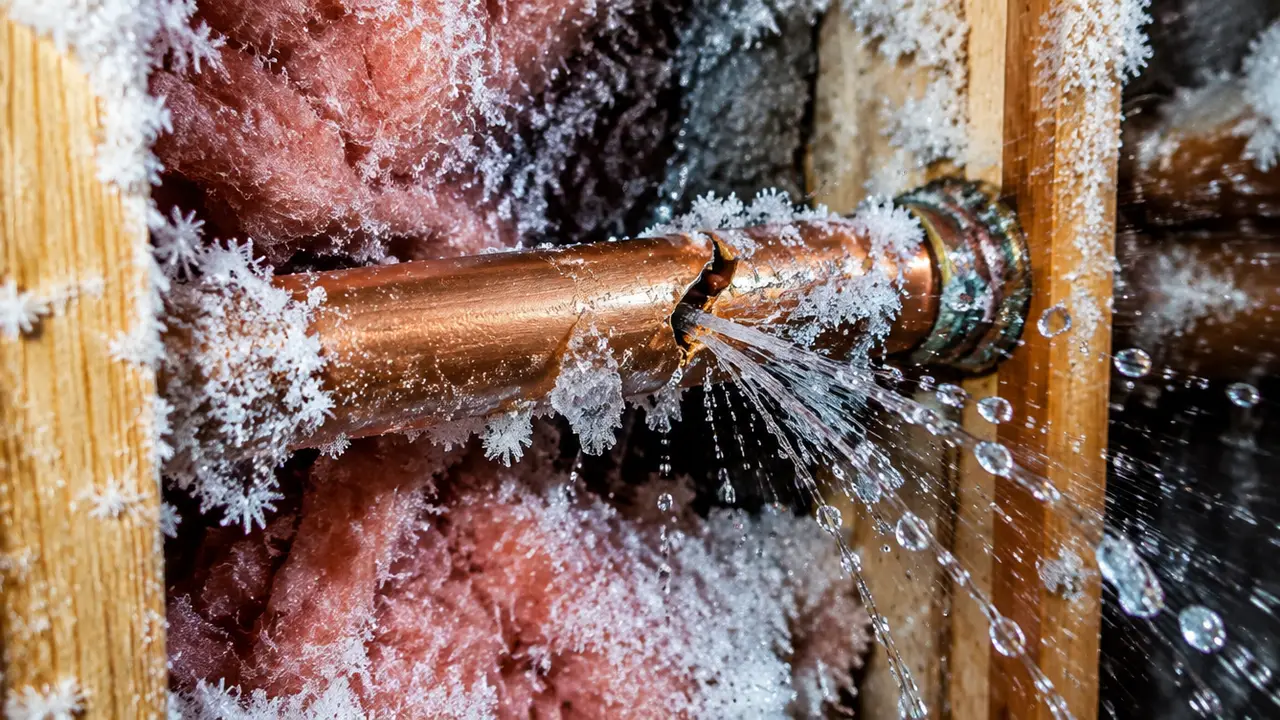
Pipes split along their length because a pressurized tube carries about twice as much stress around its circumference as along its axis. Engineers call the circumferential stress hoop stress. Once the pressure in a trapped pocket climbs high enough, the hoop stress reaches the strength of the wall first, so the pipe tears along a line parallel to its length, often as a thin slit with slightly flared lips in copper.
That shape is useful evidence. A lengthwise slit in the middle of a straight run, well away from any joint, is the classic signature of freeze pressure. A leak at a fitting or a valve body points to the same cause if it appeared during or right after a cold snap. A pinhole with green staining around it is usually corrosion, not freezing, and belongs to a different conversation.
The split tells you where the trapped water was, not where the ice was.
05 /Why does the leak show up when the pipe thaws?
The leak shows up at the thaw because the ice plug upstream was holding back the supply the whole time. People search for why pipes burst when they thaw, but the thaw only reveals damage that happened during the freeze. As soon as the plug melts, supply pressure pushes water through the line and out of any split, and a pipe that looked fine at breakfast can be spraying by lunch.
This timing has two practical consequences. First, if a line has been frozen, stay near it while it thaws, with the tap it feeds open and a clear route to the main shut-off. Second, if you see a split or water appears at any point, shut off the main water valve at once, before anything else. Handling the water that has already escaped, the drying and the repair is the job of our sister site BurstPipe.ca; this site stays with the freezing itself.
06 /Do frozen pipes always burst?
No, and understanding the pressure pocket explains which ones survive. A frozen pipe can come through without damage when the water beyond the plug had somewhere to go: a tap left open, a line that drains back to a lower open point, a short dead leg with an air pocket, or a flexible plastic line that stretched enough to absorb the growth. It is also spared when the cold ends before the plug grows or before a second plug seals the far end.
| Situation | Burst risk | Reason |
|---|---|---|
| Closed tap at the end of a frozen run | High | Water between the plug and the tap is sealed in |
| Tap left open or trickling | Much lower | Displaced water escapes through the spout |
| Line drained with valves open | Very low | Little water left to freeze |
| Short run with air trapped at a high point | Lower | Air compresses where water cannot |
| Ductile metal pipe, repeated freezes | Rises over time | Each freeze can stretch the wall before it finally tears |
| Flexible plastic tubing | Lower for the tube itself | The tube may stretch; fittings and valves can still fail |
A pipe that froze and survived is not proven safe. Copper can stretch slightly on each freeze and then split on a later one, and fittings can loosen. Treat any line that has frozen once as a line that will freeze again unless something about it changes; the guide to where pipes freeze shows what usually needs changing.
07 /What does the physics say about preventing a burst?
The physics gives three levers, and every good prevention step pulls one of them. Keep the water above 0 °C, keep it moving, or give it somewhere to go.
- Keep it above freezing: house heat reaching the pipe, air sealing around the cavity, insulation that slows heat loss, or heat cable that adds heat. See pipe insulation and heat cable.
- Keep it moving: a thin trickle replaces cold water with warmer water from underground. See does dripping a tap prevent frozen pipes?
- Give it an exit: an open tap relieves the pressure pocket even if a plug forms, and a drained line has no water to trap. Outdoor taps are the classic case; see frozen outdoor taps and frost-free sillcocks.
Insulation alone only slows the process. Foam around a pipe stretches the time to freeze, but if the cold outlasts it, the water still reaches 0 °C and the pressure mechanism works exactly the same. The How Fast Could This Pipe Freeze? calculator shows how much time a sleeve buys, and the Pipe Freeze Risk Checker turns your weather and location into a list of actions.
FAQQuestions people ask
Is it the ice or the water that breaks a frozen pipe?
Usually the water. Ice seals the pipe, and the liquid trapped between the ice and a closed tap is squeezed as more of it freezes. The pressure in that pocket breaks the pipe, typically at a spot with little or no ice.
Why did my pipe only start leaking after it warmed up?
The split happened while the pipe was frozen, but the ice plug upstream was blocking the water. When the plug melted, supply pressure reached the split and the leak began. Shut off the main at once if you see it.
How much does water expand when it freezes?
About 9 per cent by volume. That is why ice floats, and it is why a sealed pocket of freezing water builds pressure so quickly: the growing ice needs room the trapped liquid cannot give it.
Can a pipe freeze without bursting?
Yes. If the water beyond the ice can escape through an open tap, drain back, or compress an air pocket, the pressure stays low. The cold may also end before the pocket is sealed. A pipe that survived once can still split on a later freeze.
Why are burst copper pipes split along their length?
Pressure inside a tube stresses the wall about twice as much around its circumference as along its length, so the wall tears lengthwise first. A lengthwise slit away from any fitting is a typical freeze split.
Does leaving a tap open really stop a pipe from bursting?
It greatly lowers the risk. Moving water is harder to freeze, and if a plug forms anyway, the open tap lets the displaced water out instead of letting pressure build. It does not help a pipe section sealed between two plugs.