This glossary defines the words used across BurstPipes.ca to explain why pipes freeze and split, where they freeze and how to prevent it: the physics of ice and pressure, the parts of a house and a water service, outdoor taps, insulation and heat cable, pipe materials, and the weather, utility and insurance terms that come up in a Canadian winter.
- An ice plug and the pressure pocket behind it explain most burst pipes; the split usually opens where there is no ice.
- Latent heat is why freezing takes hours: water gives up far more heat turning to ice than cooling to 0 °C.
- Service line terms such as curb stop and main shut-off tell you which part of the plumbing is yours and which valve to close.
- Insulation slows heat loss; heat cable adds heat. They are different tools for different spaces.
01 /How to use this glossary
Terms are grouped loosely: freezing physics first, then the house and its air leaks, the water service and valves, outdoor taps, protection methods, pipe materials, and finally weather, utility and insurance terms. Each definition stands on its own, and where a term has its own guide the definition says where to go.
For the mechanism behind a split, start with why frozen pipes burst. For the parts of a house that run coldest, see where pipes freeze in a house. The service line vocabulary is explained in frozen water service lines and meters, and the pipe types in pipe materials and freezing.
A–ZTerms
- Air leakage
- Uncontrolled air movement through gaps in the building envelope. Moving cold air freezes pipes far faster than still cold air, so sealing leaks near pipes is a core prevention step.
- Bleed cap
- A small cap on the side of some indoor shut-off valves that is opened to let air in and drain the line to an outdoor tap after the valve is closed.
- Building envelope
- The walls, roof, floors and foundation that separate heated indoor space from the outdoors. Pipes inside the envelope's warm side rarely freeze; pipes in or beyond it are at risk.
- Cantilevered floor
- A floor that projects past the foundation below, such as under a bay window or an overhanging room. Its underside is exposed to outdoor air, and pipes routed through it freeze easily.
- Chinook
- A warm, dry wind descending the eastern slopes of the Rockies that can raise southern Alberta temperatures well above freezing within hours. After deep cold, it can make split pipes start leaking suddenly.
- Closed-cell foam
- Foam whose cells are sealed from each other, so it resists water absorption. Many pipe sleeves and rim joist boards are closed-cell.
- Colour-coded weather alert
- Environment and Climate Change Canada's yellow, orange and red alert levels, chosen from a matrix of expected impact and forecast confidence. An extreme cold alert signals cold that is unusual and disruptive for your area.
- Constant-wattage heat cable
- Heat cable with a fixed output whenever it is powered, usually controlled by a thermostat. Overlapping it is typically not allowed because it can overheat.
- Copper pipe (types K, L, M)
- Rigid copper water pipe in three wall thicknesses, K the heaviest and M the thinnest. It bulges and then splits lengthwise when a pressure pocket forms.
- CPVC
- Chlorinated polyvinyl chloride, a rigid cream-coloured plastic pipe for hot and cold water joined with solvent cement. It becomes more brittle in the cold and tends to crack when frozen.
- Crawlspace
- A shallow space under a floor, between the ground and the first floor framing. Vented or poorly sealed crawlspaces can approach outdoor temperatures in a long cold snap.
- Crimp ring
- A metal ring compressed over a fitting to seal a PEX or poly-B joint. Fittings and rings are rigid and can fail under freeze pressure even when the tube survives.
- Curb stop
- A buried shut-off valve on the water service, usually near the property line, operated by the utility with a long key. It often marks where municipal responsibility ends.
- Expansion on freezing
- Water grows by about 9 per cent in volume when it becomes ice. In a sealed space that growth is resisted by the nearly incompressible liquid, which drives the pressure up.
- Exterior wall
- A wall with the outdoors on one side. A pipe in an exterior wall should sit on the warm side of the insulation; a pipe against the sheathing is likely to freeze.
- Fixture stop
- A small shut-off valve on the supply to a single fixture, such as under a sink or behind a toilet. It isolates that fixture without shutting off the house.
- Freeze split
- The lengthwise slit a pipe develops when a pressure pocket exceeds the strength of its wall. In copper it is often a thin tear with slightly flared edges, well away from any fitting.
- Freeze-thaw cycle
- Temperatures crossing 0 °C repeatedly. Frequent cycles, common in Atlantic Canada and southern regions, test outdoor taps and pipes near the envelope many times a winter.
- Frost depth
- How far below the surface the ground freezes in winter. Water services are normally buried below the usual frost depth for the area; frost reaching deeper than usual can freeze them.
- Frost-free sillcock
- An outdoor tap with a long stem that closes at a valve seat inside the heated wall, so the barrel drains after use. It only works with the hose removed and the barrel sloped toward the outside. See the outdoor tap guide.
- Galvanized steel pipe
- Zinc-coated steel water pipe joined with threads, common in older homes. It corrodes inside, and freezing tends to split it at threaded joints or corroded spots.
- Ground-fault circuit interrupter (GFCI)
- An outlet or breaker that cuts power when current leaks to ground, such as through water. Heat cable and any electric thawing tool near water should be on ground-fault protection.
- Heat cable
- An electric heating element run along or around a pipe to replace the heat it loses; also called heat tape or heat trace. It must be certified for use in Canada and installed to its instructions.
- Hoop stress
- The stress around the circumference of a pressurized pipe wall. It is about twice the stress along the pipe's length, which is why freeze splits run lengthwise.
- Hose bib
- A standard outdoor tap whose valve closes at the outside face of the wall. It needs its indoor shut-off closed and the line drained each fall.
- Ice plug
- A section of ice that has grown across the whole bore of a pipe, sealing it. Once a plug forms, water beyond it is cut off from the main and can be trapped against a closed fixture.
- Latent heat of fusion
- The heat water must give up to change from liquid to ice at 0 °C, about 334,000 joules per kilogram. It is roughly 80 times the heat released by cooling water one degree, so freezing through takes much longer than cooling down.
- Leak indicator
- A small dial or symbol on many water meters that moves with very low flow. With every fixture off, a moving indicator means water is flowing somewhere, possibly from a hidden split.
- Low-temperature alarm
- A sensor that sends an alert when the air at its location drops below a set point. Placed in a sink cabinet, crawlspace or empty cottage, it warns before a pipe reaches freezing.
- Lumped model
- A simplified heat-transfer model that treats a body, such as a metre of water in a pipe, as having one uniform temperature. The How Fast Could This Pipe Freeze? calculator uses one.
- Main shut-off valve
- The valve inside the house, usually where the service enters beside the meter, that shuts off all water to the home. Knowing where it is and that it turns is the first prevention step.
- Pencil-thin stream
- A steady thin stream of water from a tap, the flow several Canadian utilities recommend to keep water moving in at-risk lines. It is far more effective than a slow drip.
- PEX
- Cross-linked polyethylene tubing, flexible and widely used in newer homes. The tube can often stretch through a freeze, but its rigid fittings, manifolds and valves can still crack.
- Pipe sleeve
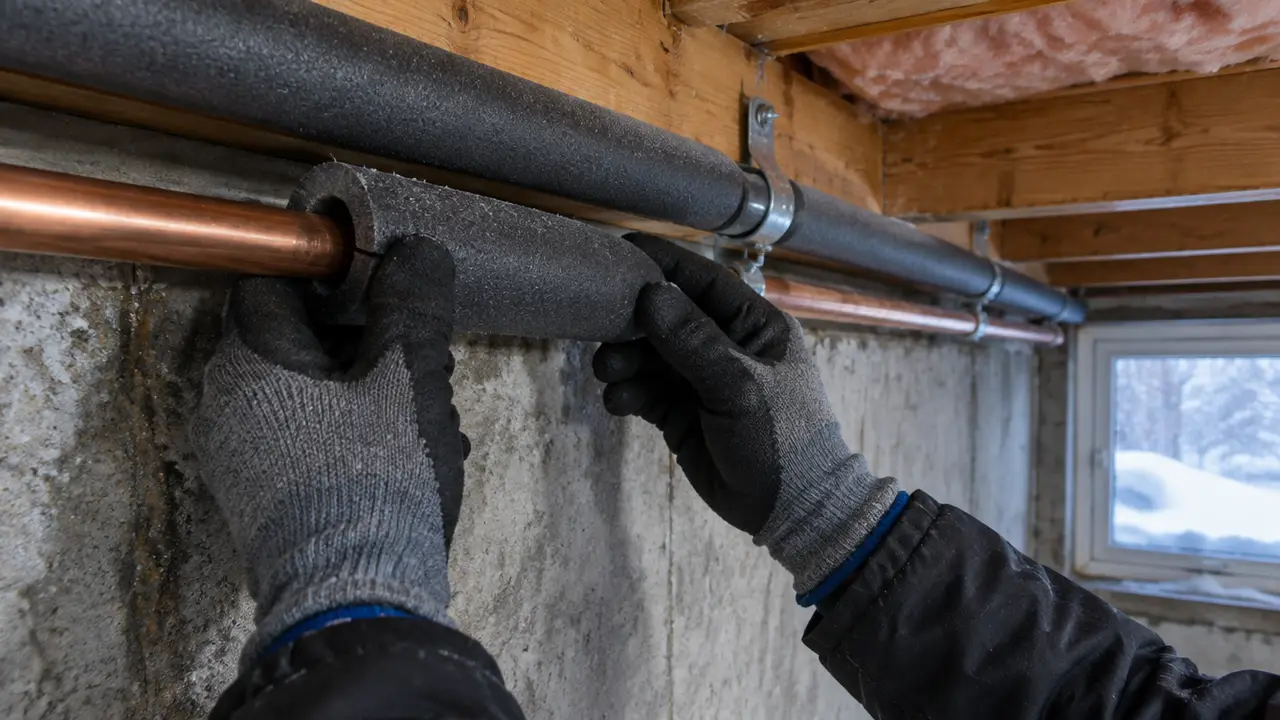
- A tube of foam insulation slit lengthwise to fit over a pipe. It slows heat loss, stretching the time before freezing, but adds no heat.
- Plumbing antifreeze
- Non-toxic antifreeze, typically propylene glycol based, sold for potable plumbing and recreational vehicles. It protects traps and toilets in a drained building. Never use automotive antifreeze.
- Polybutylene (poly-B)
- A grey flexible plastic supply pipe installed in many Canadian homes from roughly the late 1970s to the 1990s. Its fittings are its known weakness, and many insurers ask about it.
- Polyethylene service tubing
- Flexible black plastic tubing often used for buried water services and well or cottage lines, joined with insert fittings and clamps.
- Pressure pocket
- The water trapped between an ice plug and a closed tap, valve or second plug. As more of it freezes and expands, pressure in the pocket rises until the pipe, a fitting or a valve fails.
- PVC
- Polyvinyl chloride, a rigid plastic pipe used for cold water in some services and runs. Like CPVC, it cracks rather than bulges when frozen.
- Rim joist
- The framing member that caps the ends of the floor joists around the top of a foundation wall. It is a common air-leak zone, and pipes running along it often freeze first.
- Run-water program
- A municipal program asking specific at-risk properties to run a tap continuously through winter to keep a vulnerable service line from freezing, sometimes with adjusted billing. Calgary runs one from December 1 to March 31.
- Self-regulating heat cable
- Heat cable whose output rises as the pipe cools and falls as it warms. Many products can be left plugged in all winter; check the instructions.
- Service line thawing
- Thawing a buried water service with specialized equipment operated by a utility or plumber, for example by circulating warm water inside the line. It is not a homeowner job.
- Sill plate
- The wood plate anchored to the top of a foundation wall that the house frame sits on. Natural Resources Canada lists the junction of the sill plate and foundation among typical air leakage points.
- Snow cover effect
- Snow insulates the ground, so frost goes deeper where snow is cleared. A service line under a cleared driveway is more likely to freeze than the same line under a snowy lawn.
- Solder joint
- A copper pipe joint sealed with melted solder. High heat from a torch or heat gun can soften solder, one of many reasons never to thaw pipes with flame.
- Specific heat
- The heat needed to change the temperature of a kilogram of a material by one degree. For water it is about 4,186 joules per kilogram per degree.
- Stack effect
- The winter tendency of warm air to rise and leave a house near the top while cold air is drawn in low down. It pulls outdoor air past pipes near the foundation and rim joist.
- Supercooling
- Water staying liquid slightly below 0 °C before ice crystals start. Still water in a smooth pipe can supercool briefly, then freeze quickly once ice begins.
- Surface heat-transfer coefficient (h)
- How quickly heat moves from a surface into the surrounding air. It rises with air movement; the freeze-time calculator uses 8, 15 and 30 W/m²·K for still, drafty and windy air.
- Thermal conductivity (k)
- How readily a material conducts heat, in watts per metre per degree. Common pipe foams are around 0.035 W/m·K, the value used in this site's freeze-time calculator.
- Thermal resistance
- How strongly something resists heat flow. For a pipe it is expressed per metre of length; foam and the still air film around the pipe both add resistance.
- Time constant
- In a cooling model, the time it takes to close about 63 per cent of the gap between the water temperature and the air temperature. It grows with water mass and thermal resistance.
- Trap
- The curved section of drain under a fixture that holds water to block sewer gas. In an unheated building, traps can freeze and crack unless drained or protected with plumbing antifreeze.
- Vacancy clause
- Insurance policy wording that limits or excludes coverage, such as for freezing damage, when a home is vacant. The Insurance Bureau of Canada notes that freezing damage in a vacant home is typically excluded, and that most policies set how often a home must be checked while you are away.
- Vacuum breaker
- A backflow device on an outdoor tap that stops water being siphoned back from a hose into the drinking water. It must also drain, or it can freeze and crack.
- Water meter
- The device that measures water use, usually just after the main shut-off. In many municipalities a frozen or damaged meter on private property is the owner's cost; confirm with your utility.
- Water service line
- The buried pipe carrying water from the municipal main to the house. Responsibility is usually split between the municipality and the owner at a boundary such as the property line or curb stop.
- Wind chill
- An index of how cold it feels on skin in wind. Environment and Climate Change Canada notes that objects only cool to the air temperature, not the wind chill value, but wind does make them lose heat faster.
- Winterizing
- Preparing a building's plumbing for winter, from draining outdoor taps to fully draining an unheated house or cottage, including the water heater and traps. See keeping pipes from freezing when away.