Pipes burst when an ice plug traps water against a closed tap and continued freezing squeezes it until the pipe splits, usually where there is no ice. They freeze where house heat does not reach them and cold air does. Prevent it with heat, sealed drafts, insulation, a pencil-thin stream in cold snaps and drained outdoor taps, and thaw gently, never with a flame.
- If a pipe splits, shut off the main water valve at once; everything else comes after.
- Warm frozen pipes gently from the open tap back toward the ice, never with an open flame.
- A steady pencil-thin stream protects a line far better than a slow drip.
- Every tap dry at once points to the service line or meter; call your utility or 311.
01 /Quick answers, grouped by topic
These are the questions Canadians most often ask about frozen and burst water pipes, answered briefly so each stands on its own. The guides linked below go deeper. If a pipe is frozen right now, go straight to how to thaw frozen pipes safely; if water is already escaping, shut off the main and use BurstPipe.ca, the incident desk in this network.
To score a particular pipe before a cold snap, use the Pipe Freeze Risk Checker. To see how long a pipe could last in the cold, use How Fast Could This Pipe Freeze? For the vocabulary, see the glossary.
The questions run roughly from the physics of freezing, through finding and thawing a frozen line, to prevention, outdoor taps, service lines, cottages and costs. Where a city's rules matter, the answer names the city and tells you to confirm locally, because utilities set their own fees and responsibilities.
FAQAll questions
What actually makes a frozen water pipe split open?
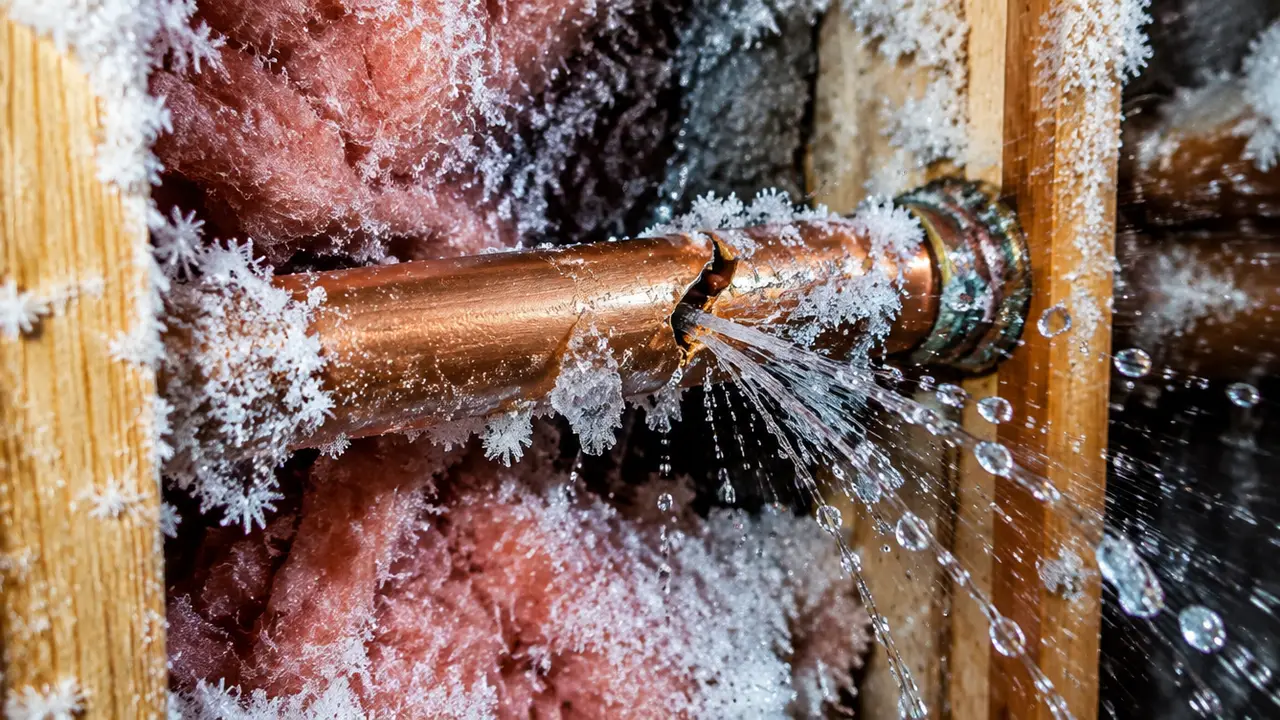
Trapped water under pressure. Ice seals the pipe at its coldest point, and the water between that plug and a closed tap has nowhere to go as more of it freezes and expands about 9 per cent. The pressure climbs until the weakest spot fails, usually where there is little or no ice. See why frozen pipes burst.
Is there an outdoor temperature at which Canadian pipes start freezing?
No single number. Exposed or unprotected pipes can freeze on any night below about −5 °C; pipes in heated interior walls survive −40 °C. Duration, drafts and how much house heat reaches the pipe matter as much as the forecast.
Can pipes freeze while the furnace is running?
Yes. Most frozen pipes in occupied homes freeze with the heat on, in exterior walls, sink cabinets on outside walls, garages and cantilevered floors where house heat does not reach.
How quickly can an exposed pipe freeze in a deep cold snap?
In hours. This site's model gives about 1.8 hours for a bare ½-inch pipe in still −20 °C air, and under an hour with a draft. Foam roughly doubles those times.
My pipe froze but did not burst. Is it safe now?
Not necessarily. Copper can stretch on one freeze and split on the next, and fittings can loosen. A pipe that froze once will freeze again unless you change its conditions.
Why do burst pipes seem to happen during warm spells?
The split usually happened during the freeze, but the ice plug upstream held the water back. When the thaw melts the plug, water reaches the split and the leak begins.
What is the first thing to do if I think a pipe is frozen?
Find the main shut-off and make sure it turns, then open the tap the frozen line feeds. That prepares you for a split and relieves pressure as the ice melts.
Is it safe to use a propane torch to thaw a pipe?
No. Never use a torch or any open flame. It can set framing and insulation on fire and create steam pockets. Use a hair dryer, warm towels, a heating pad or a warmed room instead.
How long should I keep trying to thaw a pipe myself?
Toronto says thawing can take one to six hours. If gentle heat has not brought water back within a few hours, the pipe is inside a finished wall, or you cannot find the frozen section, call a plumber.
Should the faucet be open or closed while a pipe thaws?
Open. An open faucet gives meltwater an exit, relieves pressure and shows you the moment water starts moving.
How much water should I run to keep pipes from freezing overnight?
A steady pencil-thin stream, not drops. As a guide, Winnipeg's post-thaw flow fills a 250 ml cup in about 15 seconds. Run it from the tap that the at-risk line feeds. See the dripping tap guide.
Does insulating pipes stop them freezing completely?
No. Foam slows heat loss and buys hours, but adds no heat. In a space that stays below zero for days, pair it with heat cable, flowing water or rerouting.
Is heat tape safe to use on water pipes?
Yes, if it is certified for use in Canada, approved for your pipe material, installed exactly as instructed, plugged into ground-fault protection and replaced when damaged or old. Old or damaged cable is a fire risk.
Why should the garden hose come off before winter?
A connected hose traps water in the outdoor tap. On a standard bib that water freezes at the wall; on a frost-free sillcock it stops the barrel draining and can split it inside the wall.
Why did water pour into my basement when I used the outside tap in spring?
The frost-free sillcock probably split over winter, often because a hose was left on. Close the tap and the indoor valve or main at once, and have it replaced.
Why does every tap in the house have no water on a cold morning?
The service line or meter may be frozen, or there may be a supply outage. Check your utility's outage notices, look for frost at the meter and main valve, and call your utility or 311.
Who pays when the water service line freezes?
It depends on where the freeze is and local rules. Usually the municipality handles its side and the owner pays for the private side, often including the meter. Calgary and Winnipeg publish their rules; confirm with your utility.
What thermostat setting should I leave when going south for the winter?
At least your utility's floor, such as 15 °C in Calgary or 12 °C in Winnipeg, plus a closed main valve, open cabinet doors and regular checks. For a long absence, draining the plumbing is safer.
How do I protect pipes if the power goes out in January?
Keep the house closed up and open cabinet doors on outside walls. On city water, run a thin stream at the most exposed tap. If the heat will not return before the house nears freezing, shut off the main and drain the plumbing.
Does home insurance cover pipes that froze?
The Insurance Bureau of Canada says standard policies generally cover resulting damage when the pipes were in the heated part of the home and reasonable steps were taken to maintain heat, but freezing damage in vacant homes is typically excluded. Check your own policy.
Are PEX pipes a cure for frozen pipes?
No. PEX tubing often stretches rather than splits, but it still freezes, still stops the water, and its rigid fittings and valves can crack. Keeping the pipe warm matters more than the material.
Can drain pipes freeze as well as supply pipes?
Yes, less often. Drains freeze where water sits or trickles slowly in the cold, such as a trap in an unheated space or a shallow line under a cleared driveway. The sewer side is covered by the HAUSE sewer network.
What does it cost to keep pipes from freezing?
Many steps are free. Foam sleeves run about $2 to $6 per metre DIY, a heat cable about $300 to $900 installed, and a frost-free sillcock about $250 to $600, as CAD 2026 planning estimates. See the cost page.
Where can I get help with a pipe that freezes every winter?
Start with the where pipes freeze guide to find the cause, then request quotes for a permanent fix such as rerouting, sealing the cavity or heat cable.