A small still pipe exposed to hard cold freezes in hours, not days. In this site's heat-transfer model, a bare ½-inch line in still −10 °C air cools to 0 °C in about 17 minutes and freezes through in about 3.3 more hours. Drafts can cut that to under an hour, while a foam sleeve roughly doubles it. Moving water or added heat is what actually stops it.
- Most of the time is spent freezing through at 0 °C, not cooling down to it; the latent heat is about 80 times the heat lost per degree of cooling.
- A bare ½-inch pipe in still −10 °C air takes about 3.5 hours in the model; at −20 °C about 1.8 hours; in a draft at −20 °C under an hour.
- Bigger pipes hold more water per metre of surface and take longer: a bare 1-inch line at −10 °C takes about 7.3 hours.
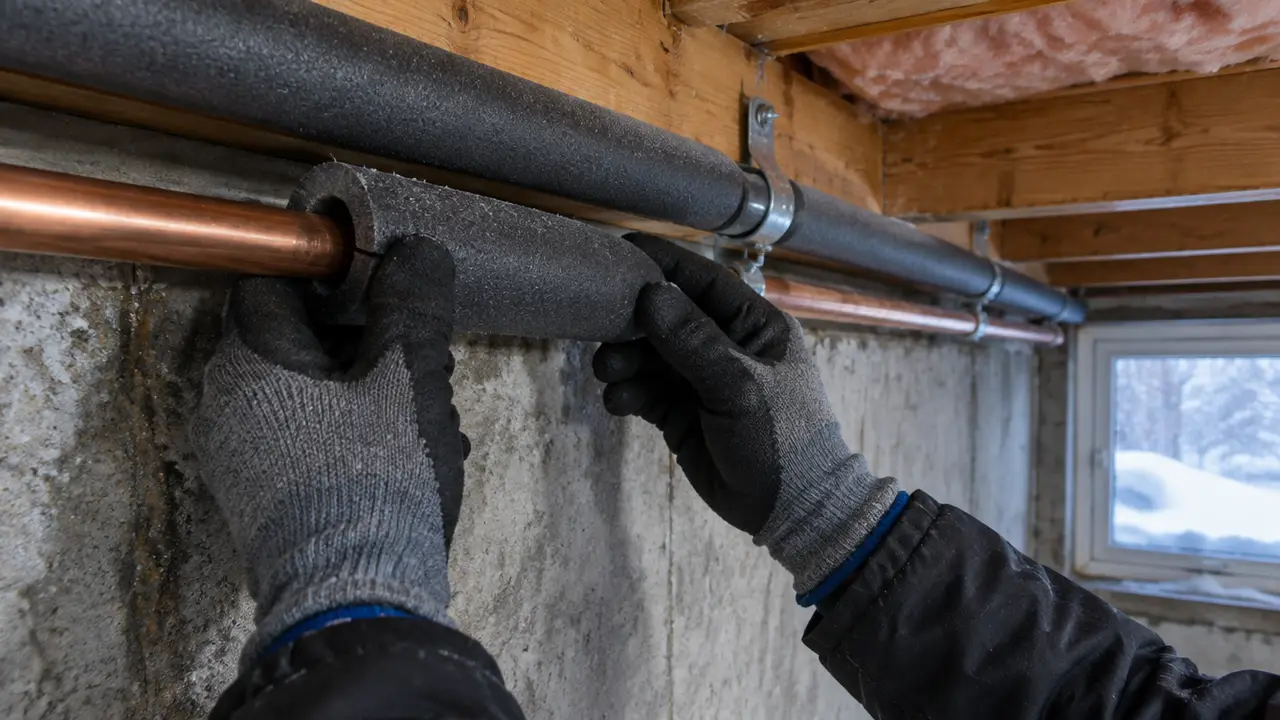
- A 13 mm foam sleeve roughly doubles the time on a ½-inch pipe; it delays freezing but does not prevent it in a long cold snap.
- Yes, pipes can freeze overnight: a twelve-hour night is longer than the model time for most small exposed pipes below −10 °C.
01 /Why does freezing take hours instead of minutes?
Freezing takes hours because water holds a lot of heat and gives up the largest part of it at exactly 0 °C. Cooling a kilogram of water by one degree releases about 4.2 kJ. Turning that kilogram into ice releases about 334 kJ more, with the temperature stuck at 0 °C the whole time. So a pipe of water starting at 10 °C has to lose about eight times more heat to freeze than it lost cooling down to 0 °C.
Meanwhile, the rate at which it can lose heat is limited. A thin film of still air around the pipe resists heat flow, and so does any foam. The colder the air and the faster it moves, the faster heat leaves. That is the whole model behind the How Fast Could This Pipe Freeze? calculator: one resistance for the foam, one for the air film, the water's heat capacity for the cooling stage and its latent heat for the freezing stage.
02 /How long does a ½-inch pipe take to freeze?
A bare ½-inch line, the size that feeds most sinks and toilets, is the fastest to freeze because it holds the least water per metre. The calculator treats it as 13 mm inside diameter with a 1 mm wall, full of still water starting at 10 °C. Here is what the model gives for different air and air movement:
| Air around the pipe | Still air | Drafty | Windy |
|---|---|---|---|
| −5 °C | about 7.0 h | about 3.7 h | about 1.9 h |
| −10 °C | about 3.5 h | about 1.9 h | about 57 min |
| −20 °C | about 1.8 h | about 58 min | about 29 min |
| −30 °C | about 72 min | about 39 min | about 19 min |
Air movement matters as much as temperature. The calculator uses heat-transfer coefficients of 8, 15 and 30 W/m²·K for still, drafty and windy air, and each step roughly halves the time for a bare pipe. That is why a small gap at the rim joist, a gap where the hose bib passes through the wall, or a garage door left open can freeze a line in the time it takes to sleep.
03 /Do bigger pipes take longer to freeze?
Yes. The water in a pipe grows with the square of its diameter, while the surface that loses heat grows only with the diameter itself, so larger lines hold more heat per square centimetre of skin. In still −10 °C air the model gives about 3.5 hours for a bare ½-inch line, 5.4 hours for ¾-inch and 7.3 hours for 1-inch.
| Pipe and foam | −10 °C | −20 °C | −30 °C |
|---|---|---|---|
| ½ inch, bare | 3.5 h | 1.8 h | 72 min |
| ½ inch, 13 mm foam | 7.4 h | 3.8 h | 2.5 h |
| ½ inch, 25 mm foam | 9.8 h | 4.9 h | 3.3 h |
| ¾ inch, bare | 5.4 h | 2.8 h | 1.8 h |
| ¾ inch, 13 mm foam | 12.9 h | 6.5 h | 4.4 h |
| 1 inch, bare | 7.3 h | 3.7 h | 2.5 h |
| 1 inch, 25 mm foam | 26.1 h | 13.3 h | 8.9 h |
The main service line entering the house, often ¾ or 1 inch, therefore tends to outlast the ½-inch branches in the same cold. Once the service does freeze, though, the whole house loses water, which is a different problem covered in frozen water service lines and meters.
04 /How much time does pipe insulation buy?
A foam sleeve roughly doubles the time on a small pipe, and a thicker one buys a bit more. With 13 mm of foam (thermal conductivity 0.035 W/m·K in the model), the ½-inch line at −10 °C goes from about 3.5 to about 7.4 hours; with 25 mm of foam, about 9.8 hours. Once there is foam on the pipe, drafts matter much less, because the foam, not the air film, becomes the main resistance: the 13 mm case in windy air still takes about 6.5 hours.
Read those numbers carefully. A cold night in a Canadian winter lasts longer than seven hours, and a cold snap lasts days. Foam is valuable because it lets a small amount of heat, from the house, from a trickle of water or from a heat cable, win the race. On its own, in a space that stays below zero, it only delays the freeze. The pipe insulation and heat cable guide covers what to pair it with.
05 /Can pipes freeze overnight?
Yes. A winter night in most of Canada runs twelve hours or more below the day's temperature, which is longer than the model time for any bare ½-inch or ¾-inch pipe below about −10 °C in a cold pocket. People are often surprised because the same pipe survived weeks of milder cold; what changed is that the temperature around it finally dropped below zero, or a wind started pushing cold air through a gap.
Nights also matter because water use stops. During the day, flushing, washing and cooking keep replacing the water in most lines with warmer water from underground. From midnight to morning, the water in a kitchen line on an outside wall sits still for six or eight hours, which is exactly when a thin trickle from the right tap earns its keep. The dripping tap guide explains how much is enough.
06 /How does starting water temperature change the time?
Less than you might expect. Starting at 20 °C instead of 10 °C adds about ten minutes to the cooling stage of a bare ½-inch line at −10 °C, and nothing to the freezing stage. Starting at 2 °C, as the water in a line near a cold foundation may be, trims only a few minutes. The freezing stage, which does not depend on the start temperature at all, is the long one.
| Water starts at | Cool to 0 °C | Freeze through | Total |
|---|---|---|---|
| 20 °C | 27 min | 3.3 h | about 3.7 h |
| 10 °C | 17 min | 3.3 h | about 3.5 h |
| 5 °C | 10 min | 3.3 h | about 3.4 h |
| 2 °C | 4 min | 3.3 h | about 3.3 h |
07 /What does the model leave out?
It is a simplified physics estimate, and its limits all point the same way: real pipes can freeze sooner or later than it says. It assumes a straight, horizontal pipe in steady air with water that never moves. Real pipes touch cold sheathing on one side and warm drywall on the other, sit next to drafts that come and go, receive heat from the house through insulation, and see water move whenever someone uses a tap.
- Contact with cold surfaces: a pipe pressed against exterior sheathing or a concrete wall loses heat by conduction faster than the air film allows.
- Heat from the house: a pipe in an insulated wall cavity gets a slow trickle of heat from the room side, which can stop freezing entirely in moderate cold.
- Supercooling: still water can drop slightly below 0 °C before ice starts, then freeze suddenly.
- Partial freezing: the bore can close long before the whole length is ice, which is what creates the pressure pocket described in why frozen pipes burst.
Use it to compare situations, such as bare against sleeved or still against drafty, and to understand why a gap or a closed cabinet door matters. Do not use it to decide that a pipe is safe. If a cold snap is coming, the Pipe Freeze Risk Checker gives an action list for your case.
FAQQuestions people ask
How many hours does it take for a pipe to freeze?
For a bare ½-inch pipe of still water, this site's model gives about 7 hours at −5 °C, 3.5 hours at −10 °C and under 2 hours at −20 °C in still air. Drafts shorten those times sharply; foam roughly doubles them.
Can pipes freeze in one night?
Yes. A winter night is long enough to freeze a small exposed pipe in a cold pocket, especially with a draft. Nights are also when nobody runs water, so the line sits still for hours.
Do insulated pipes still freeze?
They can. Insulation slows heat loss and buys hours, but it adds no heat. In a space that stays below zero for days, an insulated pipe still freezes unless house heat, heat cable or moving water makes up the difference.
Do larger pipes freeze more slowly?
Yes. A larger pipe holds more water per unit of surface, so it takes longer to lose enough heat to freeze. In the model, a bare 1-inch line takes about twice as long as a bare ½-inch line in the same conditions.
How long can the water be off before pipes freeze in an empty house?
The water being off does not protect pipes that are still full; the heat being off is the danger. A house without heat in deep cold can have frozen branch lines within a day. Drain the lines if the heat cannot be kept on.