This calculator estimates how long still water in one metre of pipe takes to cool to 0 °C and then freeze solid. Choose ½, ¾ or 1-inch pipe, no foam or a 13 or 25 mm sleeve, the air temperature, still, drafty or windy air, and the starting water temperature. A bare ½-inch pipe in still −10 °C air takes about 17 minutes plus 3.3 hours: about 3.5 hours.
- It is a lumped heat-transfer model: one thermal resistance per metre for the foam and the air film, the water's heat capacity for cooling and its latent heat for freezing.
- Worked check: bare ½-inch pipe, −10 °C, still air, water from 10 °C: about 17 minutes to 0 °C plus 3.3 hours to freeze, about 3.5 hours in total.
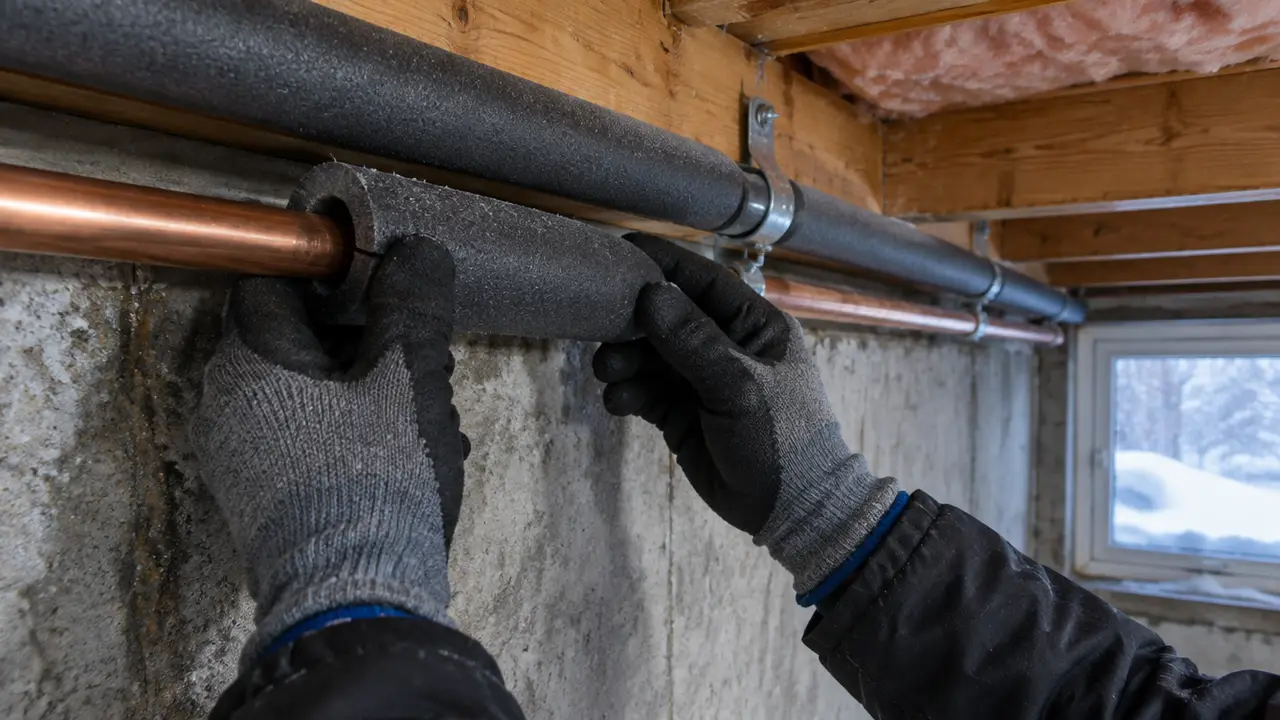
- With a 13 mm foam sleeve the same case takes about 36 minutes plus 6.8 hours, about 7.4 hours.
- Drafts matter most on bare pipe: windy air cuts the bare ½-inch case to under an hour, while the sleeved case barely changes.
- It is a simplified estimate: moving water and added heat prevent freezing, and insulation only buys time.
How Fast Could This Pipe Freeze?
01 /What does the calculator show?
It shows the two stages a pipe of still water goes through in the cold, and how long each takes. First the water cools from its starting temperature to 0 °C. Then it stays at 0 °C while it gives up its latent heat and turns to ice. The chart draws the first stage as a falling curve and the second as a flat ice bar labelled freezing solid, and the headline gives the total: about so many minutes or hours to freeze solid.
The point is comparison, not prediction. Change one thing at a time, such as bare to sleeved, still to drafty, −10 °C to −25 °C, and the calculator shows which change matters for your pipe. It pairs with the Pipe Freeze Risk Checker, which turns the same factors into an action list.
02 /What are the inputs?
| Input | Options | What the model uses |
|---|---|---|
| Pipe size | ½ inch, ¾ inch, 1 inch | Inside diameters of 13, 19 and 25 mm, with a 1 mm wall |
| Insulation | None, 13 mm foam sleeve, 25 mm foam sleeve | Foam thickness; thermal conductivity k = 0.035 W/m·K |
| Air temperature around the pipe | Any value from −45 to −1 °C; default −10 | The steady air temperature; a blank or zero entry falls back to −10, and anything warmer than −1 is treated as −1 |
| Air movement | Still air, Drafty, Windy | Surface heat-transfer coefficient h = 8, 15 or 30 W/m²·K |
| Water temperature to start | 1 to 20 °C; default 10 | The starting water temperature; a blank or zero entry falls back to 10, and anything below 1 is treated as 1 |
Enter the air temperature where the pipe actually is, not the outdoor forecast, if you know it. A remote thermometer in the sink cabinet, crawlspace or garage gives a far better number than the weather report. If you only know the outdoor temperature, use it as a worst case for a pipe in an unheated space.
03 /How does the model work?
It treats one metre of pipe as a single lump of water at one temperature, losing heat through a series of thermal resistances to the surrounding air. The steps, exactly as the calculator computes them, are:
- Radii
The inside radius rᵢ is half the inside diameter. The outside of the pipe is r₀ = rᵢ + 1 mm. The outside of the foam is r₂ = r₀ + foam thickness; with no foam, r₂ = r₀.
- Thermal resistance per metre
R = ln(r₂/r₀) ÷ (2πk) + 1 ÷ (h · 2π · r₂). The first term is the foam; the second is the air film at the outer surface. The pipe wall itself is ignored, because it is thin and conducts well.
- Water mass per metre
m = 1000 · π · rᵢ² kilograms.
- Time constant
τ = m · 4186 · R seconds, using water's specific heat of 4,186 J/kg·K.
- Cooling to 0 °C
t₁ = τ · ln((T₀ − Tₐ) ÷ (0 − Tₐ)), where T₀ is the starting water temperature and Tₐ the air temperature. This is the standard exponential cooling curve.
- Freezing solid
t₂ = m · 334,000 · R ÷ (0 − Tₐ). The water sits at 0 °C and loses its latent heat of 334,000 J/kg at a steady rate set by the temperature difference.
Times under 90 minutes are shown in minutes; longer times in hours to one decimal. The result names the conditions, such as still water, −10 °C air and bare pipe, above the headline.
04 /What are the worked checks?
Two cases confirm the arithmetic, both a ½-inch pipe with water starting at 10 °C in still −10 °C air.
| Quantity | Bare ½-inch pipe | With 13 mm foam |
|---|---|---|
| Foam resistance, ln(r₂/r₀)/(2πk) | 0 | about 4.57 K·m/W |
| Air-film resistance, 1/(h·2π·r₂) | about 2.65 K·m/W | about 0.97 K·m/W |
| Total R per metre | about 2.65 K·m/W | about 5.54 K·m/W |
| Water per metre, m | about 0.133 kg | about 0.133 kg |
| Time constant, τ | about 1,474 s (24.6 min) | about 3,080 s (51.3 min) |
| Cooling to 0 °C, t₁ = τ · ln 2 | about 17 min | about 36 min |
| Freezing solid, t₂ | about 3.3 h | about 6.8 h |
| Total shown | about 3.5 h | about 7.4 h |
One more number falls out of the same model. At 0 °C in −10 °C air, the bare pipe loses about 3.8 watts per metre and the sleeved pipe about 1.8. That is the scale of heat needed to hold the water at 0 °C, and it is why a modest heat source, whether room heat leaking into a wall cavity, a trickle of water or a heat cable under the foam, can keep a pipe from freezing at all.
05 /What does the calculator reveal about real pipes?
| Case | Still air | Drafty | Windy |
|---|---|---|---|
| ½ inch bare, −10 °C | 3.5 h | 1.9 h | 57 min |
| ½ inch bare, −20 °C | 1.8 h | 58 min | 29 min |
| ½ inch, 13 mm foam, −20 °C | 3.8 h | 3.5 h | 3.3 h |
| ¾ inch bare, −20 °C | 2.8 h | 88 min | 44 min |
| 1 inch, 25 mm foam, −20 °C | 13.3 h | 12.7 h | 12.3 h |
| ½ inch bare, −30 °C | 72 min | 39 min | 19 min |
- Freezing takes longer than cooling. The latent heat stage runs roughly ten times longer than the cooling stage for water starting at 10 °C.
- Drafts dominate bare pipe. Each step from still to drafty to windy roughly halves the time on a bare line, which is why sealing gaps at rim joists and hose bibs matters so much.
- Foam tames drafts. Once a sleeve is on, going from still to windy air shortens the time by only about 10 to 15 per cent in these cases, because the foam becomes the main resistance.
- Size buys time. Larger pipes hold more water per unit of surface; a bare 1-inch line takes about twice as long as a bare ½-inch line.
- Starting temperature barely matters. Going from 10 to 20 °C adds only about ten minutes to the bare ½-inch case at −10 °C.
06 /What does the model leave out?
The calculator describes itself as a simplified physics estimate for a still, horizontal pipe in steady air, and warns that real walls, drafts and sun change it. Do not rely on it to decide whether a pipe is safe. The main omissions all point both ways:
- Moving water. Any flow replaces cooling water with warmer water, which is why a trickle protects a line. The model assumes no flow at all.
- Added heat. Room heat reaching a wall cavity, a warm floor or a heat cable can stop freezing entirely. The model assumes none.
- Contact and radiation. A pipe touching cold sheathing or concrete loses heat faster than the air film allows; a pipe near a warm surface loses less.
- Uniform temperature. Real pipes freeze first at the coldest spot and form a plug long before the whole metre is solid, which is what creates the pressure explained in why frozen pipes burst.
- Supercooling. Still water can dip slightly below 0 °C before ice forms.
Used for what it is, it answers the useful questions: how much time does a sleeve buy, how much faster does a draft freeze a line, and why does a pipe that survived a mild week fail on the first windy night at −20 °C. The how long pipes take to freeze guide and the insulation and heat cable guide put those answers to work.
FAQQuestions people ask
How accurate is a pipe freeze time calculator?
Treat it as an order-of-magnitude estimate. It captures the physics that matters most, but real pipes gain heat from rooms, lose it by contact with cold surfaces and rarely sit in perfectly steady air.
Why does freezing take so much longer than cooling?
Turning water into ice at 0 °C releases about 334,000 joules per kilogram, roughly 80 times the heat released by cooling it one degree. The pipe has to shed all of that before it is solid.
Does the calculator account for running water?
No. It models still water only. Moving water keeps being replaced by warmer water and is far harder to freeze, which is why a steady trickle protects a line.
Why does wind change the result so much for a bare pipe?
The thin film of air around a bare pipe is its only insulation. Wind thins that film and carries heat away faster, so the surface heat-transfer coefficient rises and the freeze time falls.
Can I enter a temperature above freezing?
No. The model needs air below 0 °C to freeze water, so the air input is set up for −45 to −1 °C and treats a warmer entry as −1 °C; a zero or blank entry falls back to the −10 °C default.