A pipe is probably frozen if one tap gives nothing or a thin trickle on a cold morning while others work, a toilet will not refill, or frost shows on an exposed line. If every tap is dry, suspect the service line, the meter or a supply outage. Trace the dead fixture's line back to its coldest spot to find the ice.
- One dead fixture, or only its hot or cold side, points to a frozen branch line inside the house.
- Every fixture dead points to the service line, the meter or a utility outage; Winnipeg uses exactly that split to tell underground from internal freezes.
- Frost on an exposed pipe or on the main shut-off valve is a visible sign that both Calgary and Winnipeg list.
- Trace the frozen line from the dead fixture back toward where it enters a cold wall, garage or crawlspace; the ice is usually at the coldest, draftiest point.
- Before thawing, locate the main shut-off, because a line that froze may already be split.
01 /What are the signs of a frozen pipe?
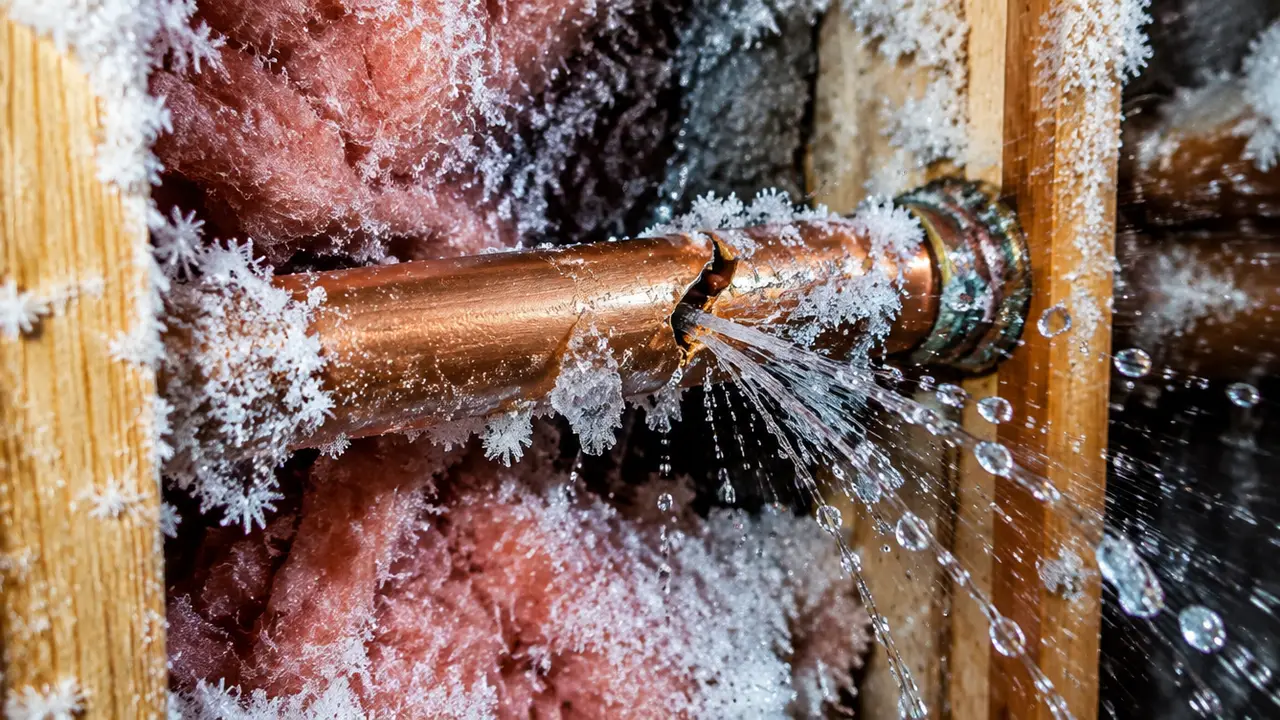
The clearest sign is a tap that suddenly gives no water, or a weak trickle, on a cold morning when it worked the evening before. Municipal utilities list the same short set of signs: very little or no water from the faucets, visible frost on internal pipes or on the main shut-off valve, and damp areas or flooding where a frozen pipe has burst.
| What you notice | Most likely meaning | Next step |
|---|---|---|
| One tap has no water; others work | A branch line to that fixture is frozen | Open that tap; trace its line to the cold spot |
| Only the hot side (or only the cold) is dead at one sink | That one supply line is frozen | Check the line in the exterior wall or cabinet |
| Toilet will not refill after a flush | Its supply line or fill valve area is frozen | Look for the line running along a cold wall or floor |
| All taps dead or barely running | Service line or meter frozen, or a supply outage | Check for outages; call your utility or 311 |
| Frost on an exposed pipe | The water inside is at or near 0 °C | Treat that section as frozen or about to be |
| Water pressure dropping over a cold night | Ice is narrowing a line somewhere | Start a trickle; open cabinet doors now |
| A damp patch, drip or hiss after a thaw | A frozen section has split | Shut off the main water valve at once |
Washing machines and dishwashers often reveal a frozen line first because their supply runs to a cold laundry corner or through an exterior wall. An error code about water fill on a cold morning deserves a look at the supply before anyone blames the appliance.
02 /Is the freeze inside the house or in the service line?
The quickest test is to try every fixture. The City of Winnipeg uses this exact split: very little or no water from all faucets suggests an underground freeze, while some faucets flowing and others weak or dry suggests internal plumbing. Before assuming a freeze, check whether your utility has reported a water outage or main break in your area.
- Try the lowest cold tap first
The laundry tub or basement sink is closest to where the water enters. If it runs normally, the service line and meter are fine and the freeze is in a branch line.
- Try each floor and both sides
Run hot and cold at a sink on each floor and flush each toilet. Note which fixtures are dead and which work.
- Check the meter and the main shut-off
Look for frost on the pipe where it comes through the floor or wall, at the meter and at the main valve. Frost there, with every tap dry, points to the service or the meter.
- Check with the utility
If everything is dry and there is no frost inside, look up your utility's outage map or call 311 or its emergency line. A main break down the street looks exactly like a frozen service from inside the house.
If the freeze is in the service line or the meter, the approach is different: those lines are underground or at the foundation, responsibility may be split with the municipality, and many utilities have their own thawing process. See frozen water service lines and meters.
03 /How do I find the frozen section of a pipe?
Start at the dead fixture and follow its supply line back toward the basement, looking for where it passes through the coldest space. The ice is almost always at the point of greatest heat loss: a section in an exterior wall, a run along the rim joist, a pipe crossing a garage ceiling or a crawlspace, or a spot next to a draft.
- Feel the pipe. A frozen section is noticeably colder than the rest, and it may have visible frost or a bead of condensation just beyond it.
- Use a thermometer. An inexpensive non-contact infrared thermometer pointed along the pipe will show the drop where the ice is. Readings near 0 °C or below on a copper line are a strong hint.
- Look for bulges. Copper can swell before it splits. A bulge or a visible crack means the section is damaged; shut off the main before thawing it.
- Think about hidden runs. If the line disappears into a finished exterior wall, the ice is probably inside that wall, near the floor or near a window where insulation is thinnest.
- Check the outside tap line. A frozen hose bib line can back up into the branch feeding it. The outdoor tap guide explains how.
04 /Does a frozen pipe make a noise?
Sometimes, but sound is an unreliable clue. People report creaking or ticking as pipes cool and move against framing, and gurgling or knocking when a partly frozen line lets water through. None of those sounds proves ice. The sound that matters is running water or hissing when every tap is off, especially during a thaw, because that usually means a split.
Many water meters have a small low-flow or leak indicator on the dial. With every fixture off, including the ice maker and any humidifier, a moving indicator means water is flowing somewhere in the house. After a freeze, that simple check can reveal a split inside a wall before the stain appears.
05 /How can I tell if a frozen pipe has already burst?
While the ice plug holds, you often cannot: a split section stays dry until the plug melts. That is why the moments during and just after thawing matter most. Watch the section you are warming, keep the tap it feeds open, and listen for water. A burst usually announces itself as a drip, a spray, a hiss, water on the floor, or a damp patch on drywall or ceiling below the pipe route.
Once the water is off, the response moves to stopping damage, drying and repair, which belong to BurstPipe.ca, the incident desk in this network. Back here, the job is to understand why that line froze so it does not happen again; the where pipes freeze guide covers the usual causes.
06 /What should I do once I know the pipe is frozen?
- Find the main shut-off and make sure you can turn it. Put a flashlight beside it.
- Open the tap that the frozen line feeds, both hot and cold if you are unsure which side is frozen. The open tap relieves pressure and shows you when water starts to move.
- Warm the frozen section gently, starting nearest the open tap and working back toward the ice. Never use an open flame.
- Keep watching for leaks as it thaws, and be ready to close the main.
- Once water runs, keep a thin trickle going until the cold snap breaks, and fix the cause before the next one.
The safe methods, what not to use and how long it usually takes are in how to thaw frozen pipes safely. If you cannot find the frozen section, it is inside a finished wall, or the service line is frozen, call a plumber or your utility. You can also request help through this site.
FAQQuestions people ask
How do I know if my pipes are frozen or the water is just off?
Try every tap. If some work and others do not, a branch line is frozen. If all are dry, check your utility's outage notices first; with no outage and frost at the meter or main valve, the service line may be frozen.
What does a frozen pipe look like?
Often nothing obvious. Exposed pipes may show frost, a bead of condensation beside the ice, or a slight bulge in copper. Most frozen sections are hidden in walls, floors or cabinets, so the missing water is the main clue.
Why is only my hot water frozen?
The hot line to that fixture runs through a colder spot than the cold line, or it sat still longer. Hot lines cool to their surroundings between uses and freeze like any other line.
Can a toilet stop refilling because of frozen pipes?
Yes. If its supply line runs along an exterior wall or through a cold floor, it can freeze and stop the tank from filling. Other fixtures may still work.
Can frozen pipes cause low water pressure?
Yes. Ice narrowing a line reduces the flow before it blocks it completely. Falling pressure at one fixture on a cold night is an early warning; start a trickle and warm that area.
Should I call 311 for a frozen pipe?
Many cities want a call when every tap is dry, because the freeze may be on the service line or the city's side. For a single frozen branch inside the house, a plumber is usually the right call.