Outdoor taps freeze because their water sits at the exterior wall with no house heat. A standard hose bib needs its indoor valve shut and the outside line drained each fall. A frost-free sillcock closes inside the heated wall so its barrel drains, but only if it slopes outward and no hose is attached; a connected hose traps water and can split it inside the wall.
- Winnipeg calls outdoor faucets the first to freeze; Toronto, Calgary, Winnipeg and EPCOR all say to disconnect hoses and shut off and drain outdoor taps before winter.
- A frost-free sillcock only works when its barrel can drain: it must slope toward the outside, and the hose must be off.
- A frost-free tap that split over winter often stays hidden until spring, when the first use sends water into the wall or basement.
- After draining, leaving the outside tap slightly open gives any water left in it room to expand, as Winnipeg's guidance notes.
- The Pipe Freeze Risk Checker scores a hose bib or outdoor pipe at 5, the highest location value.
01 /Why do outdoor taps freeze first?
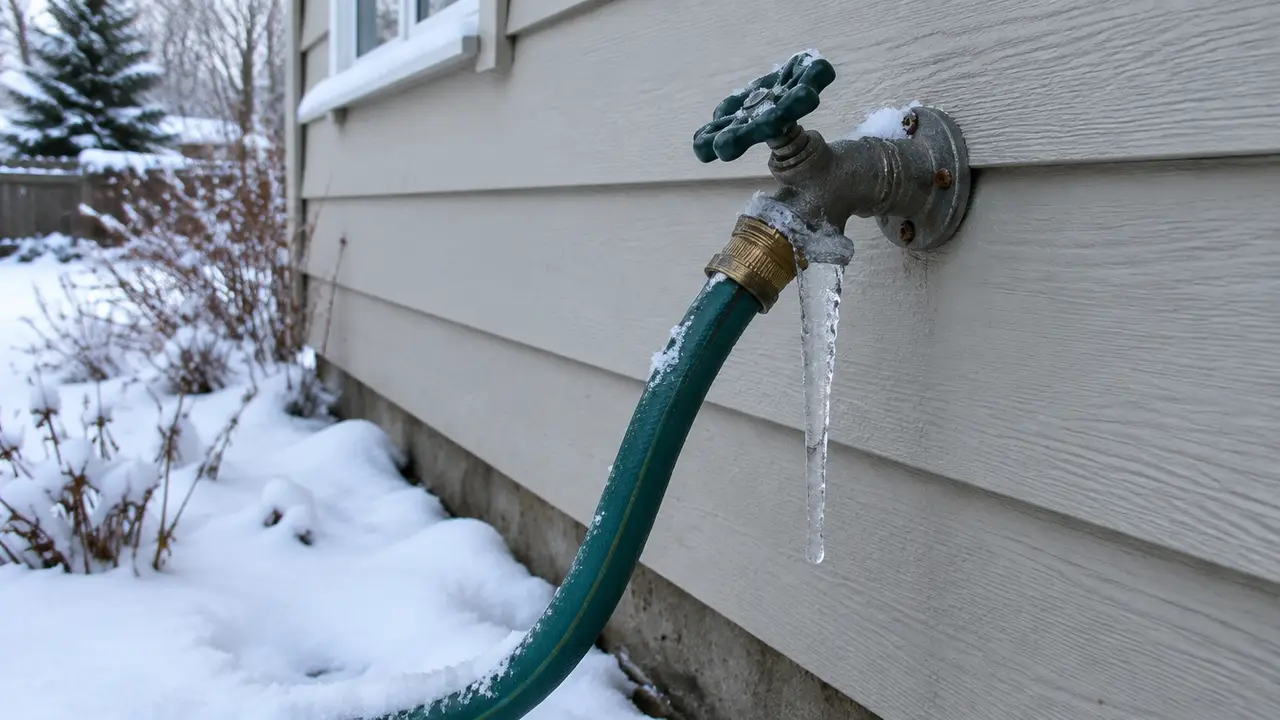
Outdoor taps freeze first because the water in them is outside the heated envelope or right at its edge. A standard hose bib has its valve at the exterior face of the wall, so the water held behind the valve sits in the coldest part of the wall and the tap body itself sits in outdoor air. Winnipeg's prevention advice says it directly: outdoor faucets are first to freeze.
An outdoor tap that freezes can do more damage than it looks. The split may be in the pipe inside the wall or the rim joist, not in the visible tap, and the ice can seal a pocket back toward the house. In the Pipe Freeze Risk Checker, a hose bib or outdoor pipe carries 5 location points, and choosing it adds an action to disconnect hoses and shut and drain the bib from its indoor valve.
02 /How do I winterize a standard hose bib?
- Disconnect every hose
Remove hoses, splitters, timers and quick-connect fittings. A hose left on traps water in the tap. Store the hose drained.
- Find the indoor shut-off
Follow the line from the outside tap to a small valve on the basement ceiling or wall, usually within a metre or two of the exterior wall. Many have a small drain or bleed cap on the side.
- Close the indoor valve
Turn it fully closed. If it will not close or leaks at the stem, note it; a valve that does not hold is worth replacing before winter.
- Open the outside tap
Let the water between the indoor valve and the outside tap run out. If nothing comes out at all, the valve may not be the one feeding that tap.
- Open the bleed cap indoors
With a small container underneath, open the bleed cap on the indoor valve to let air in so the line drains fully, then close it.
- Leave the outside tap slightly open
Winnipeg's guidance is to leave outdoor taps slightly open so any remaining water has room to expand when it freezes. Many homeowners leave it open all winter as a reminder.
Toronto's version is short: unscrew hoses, turn off the outdoor water supply and let the taps drain. Calgary lists winterizing outdoor faucets by turning them off, disconnecting and draining the lines. EPCOR adds winterizing irrigation systems by insulating components and shutting off the timer and main valve.
03 /How does a frost-free sillcock work?
A frost-free sillcock moves the valve inside the house. The handle is outside, but a long stem runs through a tube in the wall to a valve seat several inches to more than a foot inside, where the house keeps it above freezing. When you close the handle, the water stops inside the heated space, and the water left in the tube between the seat and the spout drains out of the spout.
| Feature | Standard hose bib | Frost-free sillcock |
|---|---|---|
| Where the valve closes | At the outside face of the wall | Inside the heated wall, at the end of a long stem |
| Winter routine | Shut the indoor valve, drain the line, leave the tap open | Remove the hose; confirm it drains |
| Main way it fails | Water left in the tap or line between valve and wall | Hose left on, or barrel sloped inward so water stays in |
| Where the split shows | Usually visible at the tap or just inside | Often inside the wall, found in spring |
| Needs an indoor shut-off? | Yes, to drain it | Recommended, for repairs and extra protection |
04 /Why do frost-free sillcocks still freeze and burst?
Frost-free taps fail for three reasons, and all three trap water in the part of the barrel that sits in the cold wall.
- A hose left connected. With a hose on, closing the handle leaves the barrel full, because water cannot drain back past the hose. The barrel freezes, a pressure pocket forms against the closed seat, and the tube splits inside the wall.
- Wrong slope. The barrel must slope slightly down toward the outside so it drains. If it was installed level or sloping inward, or the house has settled, water stays in it.
- A tap too short for the wall. If the valve seat ends up in the insulation or at the rim joist rather than inside heated space, the seat itself can freeze. Thick walls need a longer model.
A vacuum breaker on the spout, which protects the drinking water from being drawn back out of a hose, can also hold a little water if it does not drain properly, and it can freeze and crack on its own. Check that it vents water when the tap is closed.
05 /How do I know if my outdoor tap burst over winter?
A split frost-free tap is usually discovered on the first warm day of spring. The tap works fine for the first few seconds, then water starts running inside the wall, from the rim joist or down the basement wall or ceiling below the tap. That is because the split sits in the barrel between the seat and the spout, and only water flowing past the open seat reaches it.
- Test it on purpose. The first time you open the tap in spring, have someone watch the basement ceiling and wall under it.
- Watch the flow. Weak flow from the spout with the handle fully open can mean water is escaping inside.
- Check the indoor side. Look for stains or damp drywall near where the tap enters.
- Close it fast. If water appears indoors, close the outside handle and the indoor shut-off, or the main.
Water that has already escaped is handled on BurstPipe.ca, the incident desk in this network. Replacing the tap is the moment to fix whatever let it freeze: a longer model, a correct slope, or sealing and insulating the penetration.
06 /Should I replace a standard hose bib with a frost-free one?
In most of Canada, replacing a standard bib with a correctly sized frost-free sillcock is one of the most worthwhile small plumbing upgrades. It removes the fall routine for most houses, and it moves the water out of the wall's coldest zone. Keep or add an indoor shut-off so the tap can be isolated for repairs and fully drained in extreme cold or when the house will be empty.
Get the details right: a length that places the seat inside the heated space, a slight slope toward the outside, a sealed and insulated penetration so outdoor air does not blow along the pipe, and a model with backflow protection. The plumbing code in your province governs connections to the drinking water supply; installers and your municipality can confirm what applies. Planning costs are on the prevention cost page, and you can request quotes for the swap.
07 /What about irrigation, pools and outdoor kitchens?
Anything outside that holds water under pressure needs the same logic: shut it off inside the heated space, drain it, and leave a way for leftover water to expand. Underground irrigation is normally blown out with compressed air by an irrigation contractor in the fall, and its backflow preventer, often mounted outdoors, must be drained or removed. EPCOR's advice includes shutting off the irrigation timer and main valve and insulating components.
Water lines to detached garages, sheds, barns and shops are buried service lines in miniature. If they are not below frost depth and not heated, they need to be drained for winter or protected with heat cable and insulation. The frozen water service lines guide explains frost depth and cleared-snow effects.
FAQQuestions people ask
Do I need to shut off a frost-free outdoor faucet in winter?
Most frost-free sillcocks do not need the indoor valve closed, provided the hose is off and the barrel drains. Closing and draining it too adds protection in extreme cold, in an empty house, or where the tap is known to be marginal.
Can a frost-free sillcock freeze with the hose attached?
Yes. A connected hose stops the barrel draining, so water stays in the part inside the cold wall. That is the most common reason frost-free taps split.
Should I leave the outdoor tap open or closed for winter?
For a standard bib, close the indoor valve, drain the line and leave the outside tap slightly open. For a frost-free tap, close the handle and remove the hose so it drains.
How do I know if my frost-free sillcock is broken?
Watch the basement wall and ceiling the first time you use it in spring. Water appearing inside, weak flow at the spout, or a damp patch near the penetration means the barrel has split.
Can I use heat tape on an outdoor faucet?
It is better to shut off and drain an outdoor tap, or replace it with a frost-free model, than to try to keep it heated. Heat cable suits exposed supply pipes, not taps you intend to use outdoors in winter.
Why is water leaking inside when I turn on my outside tap?
Most often a frost-free sillcock split over winter, usually because a hose was left on. Close the tap and the indoor valve or main, and have the sillcock replaced.