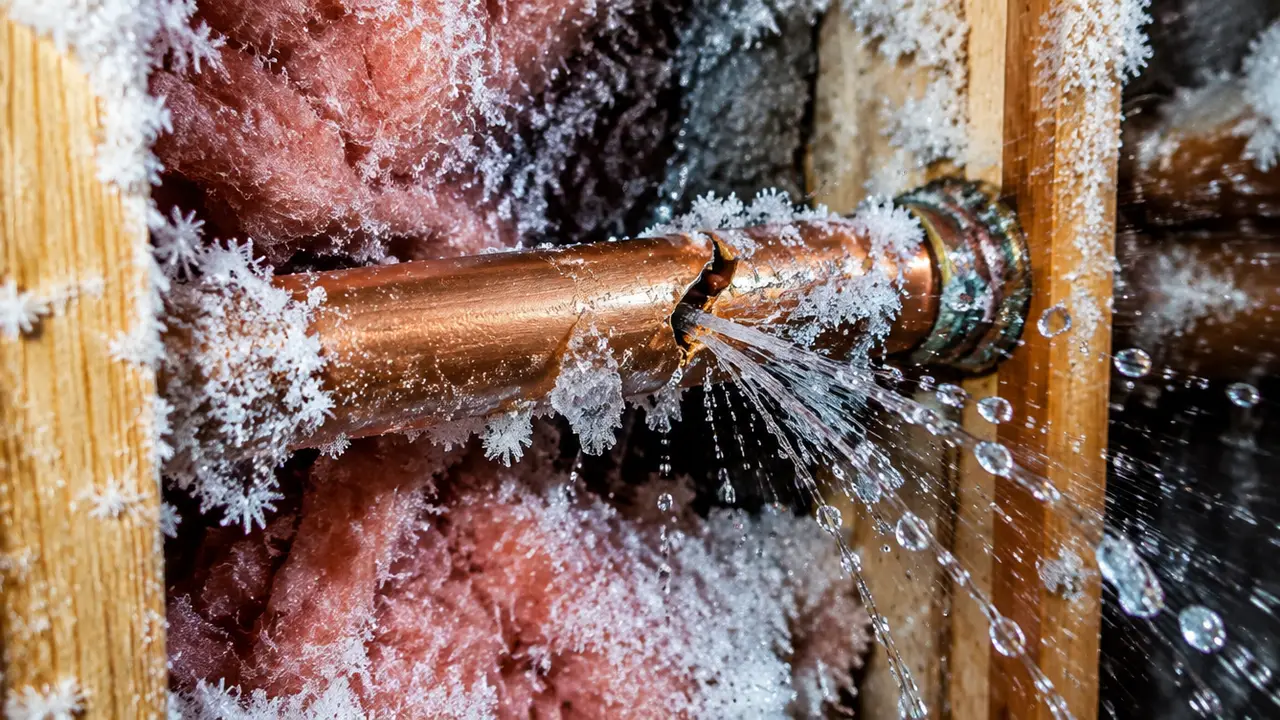
Pipes freeze where house heat does not reach them and cold air does: hose bibs and outdoor lines, attics, crawlspaces, unheated garages, cantilevered floors and bay windows, exterior walls and sink cabinets on outside walls. The coldest spot is usually a pipe near an air leak at the rim joist or sill plate. A pipe that froze once will freeze again until that spot changes.
- Hose bibs, attics, crawlspaces, garages and cantilevers are the highest-risk locations; exterior walls and sink cabinets on outside walls are next.
- Air leaks decide more than the location itself: Natural Resources Canada lists the sill plate and pipe penetrations among the common leakage points.
- A line that freezes every winter has a fixable cause, usually a draft, a closed-off cavity or a pipe laid against cold sheathing.
- Kitchen sinks on outside walls, basement laundry lines near the rim joist and the pipe feeding an upstairs bathroom over a garage are the classic repeat offenders.
- The Pipe Freeze Risk Checker weights location from 0 for a heated interior wall to 5 for an attic or hose bib.
01 /Which pipes in a house freeze first?
The pipes that freeze first are the ones outside the heated envelope or pressed against its cold edge. In most Canadian houses that means, in rough order: outdoor taps that were not shut off and drained, pipes in attics, pipes in crawlspaces and unheated garages, pipes under cantilevered floors and bay windows, pipes in exterior walls, and supply lines in sink cabinets on exterior walls. Pipes in interior walls of a heated house rarely freeze unless the heat fails.
| Location | Checker points | Why it runs cold | First fix |
|---|---|---|---|
| Hose bib or outdoor pipe | 5 | Water sits at or past the wall with no house heat | Disconnect the hose; shut and drain from inside |
| Attic | 5 | Above the insulation, often at outdoor temperature | Reroute below the insulation, or insulate over it |
| Crawlspace or cold basement corner | 4 | Vents, rim joist leaks and bare concrete | Seal leaks; insulate the line; add heat if needed |
| Unheated garage | 4 | Big door, little insulation, cars bring in cold | Keep the door shut; insulate or reroute |
| Cantilevered floor or bay window | 4 | Floor overhangs the foundation; thin, leaky underside | Air seal and insulate the cavity, or reroute |
| Exterior wall | 3 | Pipe sits against cold sheathing or in a draft | Seal the cavity; move the pipe to the warm side |
| Under a sink on an exterior wall | 3 | Closed cabinet traps cold air around the supply | Open the cabinet doors in cold snaps |
| Heated interior wall | 0 | Surrounded by room air | Know where the main shut-off is |
Those point values come straight from the Pipe Freeze Risk Checker, which adds them to points for the forecast cold, its duration, protection, house heat, drafts and history. Location alone does not decide the outcome, but it sets how much the other factors have to go wrong.
02 /Why do air leaks matter more than the location?
Air leaks matter more because moving cold air strips heat from a pipe many times faster than still cold air. A pipe in an insulated exterior wall with no drafts may never freeze, while the same pipe a few centimetres from a gap at the rim joist can freeze in a single night. In this site's freeze-time model, going from still to windy air cuts the time to freeze a bare ½-inch line roughly fourfold.
Natural Resources Canada's Keeping the Heat In guide lists typical leakage points, including where the wood-frame wall meets the foundation at the sill plate and the holes where pipes, wiring and services pass through walls. It also describes the winter stack effect, where air enters the house at lower levels and leaves at the top. Put those together and you have the classic frozen basement line: a supply pipe running along the top of the foundation wall, right at the sill plate, in the path of air being pulled in at the bottom of the house.
03 /Why do kitchen sinks on outside walls freeze so often?
Kitchen sinks freeze because they combine three risks. The sink often sits under a window on an exterior wall, so the supply lines climb through the coldest part of the wall. The cabinet doors are closed, so room heat cannot reach the space behind the sink base. And the lines sit still all night. A frozen kitchen cold line with a working hot side, or the reverse, is one of the most common winter calls.
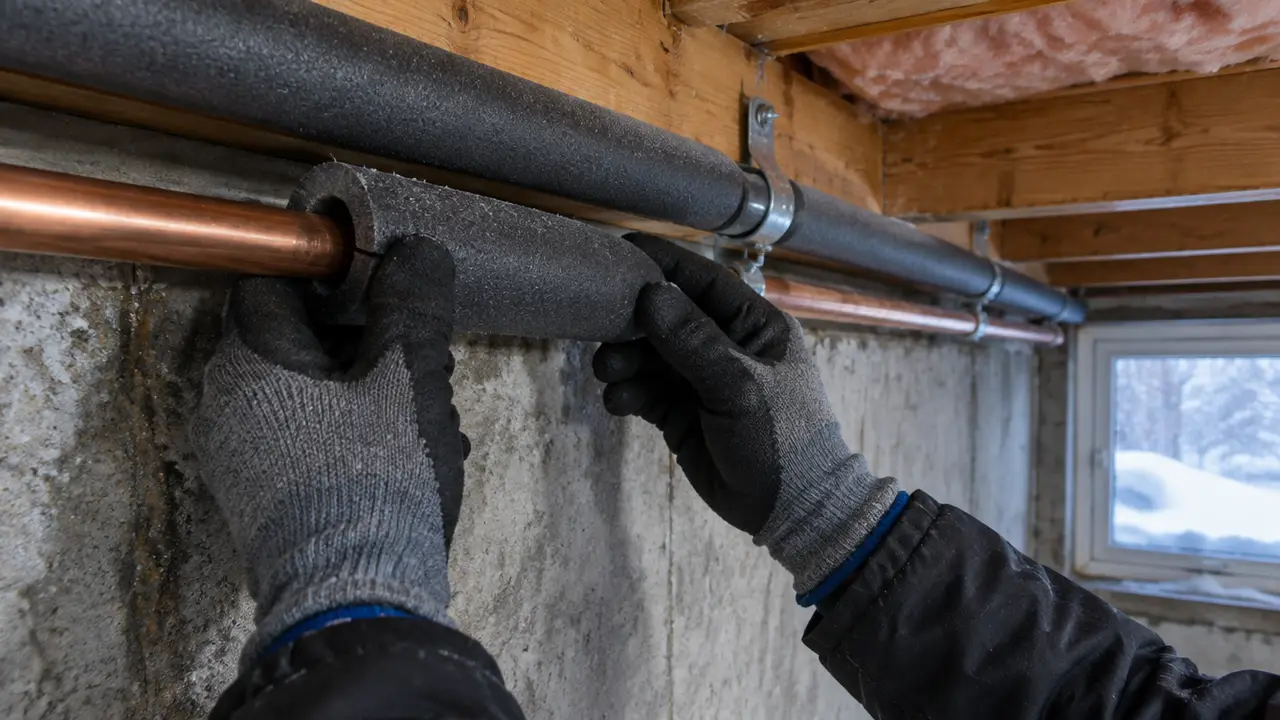
The fixes are cheap and in the order of effect: open the cabinet doors during cold snaps so room air reaches the pipes, seal any gap where the pipes enter the cabinet from the wall or floor, insulate the exposed lines, and run a thin trickle overnight in the worst weather. If it freezes every year despite all that, the lines are probably pressed against the sheathing inside the wall, and moving them to the warm side of the insulation is the permanent fix.
04 /Why does the bathroom over the garage freeze?
A bathroom over an attached garage often has its supply lines running through the garage ceiling or the floor between the garage and the room above. That floor is a boundary between a heated room and a space that can drop well below zero, and the pipes in it may sit on the cold side of the insulation. If the upstairs bathroom has no water while the rest of the house is fine, this is the first place to look.
Cantilevered floors and bay windows behave the same way. The floor projects past the foundation, its underside is exposed to outdoor air, and the soffit below is often poorly sealed. Pipes routed through that overhang to reach a kitchen island or a bathroom are exposed on three sides. The durable fixes are to seal and insulate the cavity so the pipe sits on the warm side, or to reroute the pipe through the heated interior.
05 /What about crawlspaces, cottages and mobile homes?
Crawlspaces are among the worst spots because they combine bare concrete or soil, outside vents, rim joists that leak and very little heat. Winnipeg's prevention advice specifically lists insulating unheated garages, attics, basements and crawlspaces. In a vented crawlspace, the pipes can see temperatures close to outdoors in a long cold snap.
Cottages, seasonal cabins and mobile homes add the risk of being lightly heated or empty. Their supply lines often run under the floor in an open or skirted space, and they may be fed from a lake line or a shallow well line that is itself exposed. Those cases need a plan for the whole winter rather than a cold-snap routine, which is the subject of keeping pipes from freezing when away.
06 /Why does the same pipe freeze every winter?
A pipe that freezes every winter has a specific, fixable cause, and each freeze makes the next one more damaging, because copper can stretch and fittings can loosen a little each time. Look for one of these patterns:
- It sits against the sheathing. The pipe was installed on the cold side of the wall insulation. Opening the wall and moving it to the room side, or insulating between the pipe and the sheathing, solves it.
- There is a draft at a penetration. A gap where the pipe, a vent or a wire passes through the rim joist or wall lets air flow over the pipe. Sealing the gap may be enough.
- The cavity is closed to house heat. Insulation installed around the pipe on all sides, including the room side, can isolate it from the heat that used to keep it thawed.
- It runs through an unheated space. Garages, crawlspaces and cantilevers may need heat cable on an insulated pipe, or a reroute through the heated interior.
- Something changed. New insulation, a sealed-up furnace room, a new door or window, or a renovation can move warm air away from a pipe that used to be fine.
The Pipe Freeze Risk Checker adds 2 points when a pipe has frozen before and suggests rerouting it, adding heat cable, or sealing and insulating the cavity. Planning costs for those fixes are on the frozen pipe prevention cost page.
07 /Can drains and vent stacks freeze too?
Yes, though less often than supply lines, because drains are normally empty between uses. A drain freezes where water sits or trickles slowly in the cold: a trap in an unheated space, a sagging section that holds water, a washing-machine or condensate line discharging outdoors, or a building sewer that is shallow under a cleared driveway. A plumbing vent can close with frost at the roof in long cold spells, which shows up as gurgling drains or slow toilets. Sewer-side freezing is outside this site's lane; the HAUSE sewer network, starting with SewerJetting.ca, covers how frozen drain and sewer lines are cleared.
FAQQuestions people ask
Which pipes are most likely to freeze in a house?
Outdoor taps that were not drained, then pipes in attics, crawlspaces, unheated garages and cantilevered floors, then pipes in exterior walls and sink cabinets on outside walls. Interior pipes in a heated house rarely freeze unless the heat fails.
Why does only my kitchen sink freeze?
The kitchen sink is often on an exterior wall under a window, with its lines in the coldest part of the wall and closed cabinet doors in front. Open the doors in cold snaps, seal gaps into the cabinet and insulate the lines.
Why is there no water upstairs but water downstairs?
The line feeding the upstairs fixtures probably runs through a cold space such as the garage ceiling, a cantilevered floor or an exterior wall. The lower floors are fed from a warmer route. Trace the upstairs line back toward the basement.
Can pipes freeze in an apartment or condo?
Yes, usually in units with plumbing on exterior walls, above parkades or near balcony doors. Keep the heat on, open cabinet doors and report a frozen line to building management early, because shared risers can affect other units.
Is a pipe in the basement safe from freezing?
Not always. Pipes along the top of the foundation wall run right at the sill plate and rim joist, a common air-leak zone. Pipes in an unheated or partly finished basement corner can freeze in a long cold snap.
Why did my pipe freeze this year when it never did before?
Something changed: colder or windier weather, a new draft, insulation that now isolates the pipe from house heat, a lower thermostat setting, or a room that used to be heated and no longer is.