Pipe insulation slows heat loss but adds no heat, so it buys hours, not immunity: a 13 mm foam sleeve roughly doubles the time a ½-inch pipe takes to freeze. Heat cable adds heat and can keep a pipe above freezing indefinitely while the power is on. Use foam where the pipe gets some house heat; use certified, thermostat-controlled cable under insulation where it gets none.
- Foam is a delay: in this site's model, 13 mm on a ½-inch pipe at −10 °C stretches freezing from about 3.5 to 7.4 hours; 25 mm to about 9.8 hours.
- Insulation works best when a small heat source, such as house heat, flowing water or heat cable, can win against the slowed heat loss.
- Never insulate a pipe in an exterior wall on its warm side only; that cuts it off from house heat and can make freezing more likely.
- Heat cable must be certified for use in Canada, installed to its instructions, plugged into ground-fault protection and checked each fall.
- Both depend on sealing drafts first, and heat cable stops working in a power outage.
01 /Does pipe insulation stop pipes from freezing?
Pipe insulation slows freezing; it does not stop it on its own. Foam has no heat to give. It reduces the rate at which the water loses heat, which stretches the time before the water reaches 0 °C and freezes through. If the pipe sits in a space that stays below zero longer than that, the water freezes anyway, just later.
The numbers from this site's How Fast Could This Pipe Freeze? calculator show the scale. It models foam with a thermal conductivity of 0.035 W/m·K, typical of common closed-cell pipe foams.
| Pipe and insulation | −10 °C air | −20 °C air | −30 °C air |
|---|---|---|---|
| ½ inch, bare | about 3.5 h | about 1.8 h | about 72 min |
| ½ inch, 13 mm foam | about 7.4 h | about 3.8 h | about 2.5 h |
| ½ inch, 25 mm foam | about 9.8 h | about 4.9 h | about 3.3 h |
| ¾ inch, bare | about 5.4 h | about 2.8 h | about 1.8 h |
| ¾ inch, 25 mm foam | about 17.4 h | about 8.8 h | about 5.9 h |
Two lessons come out of that table. First, even thick foam on a small pipe in an unheated space gives less than half a day at −20 °C. Second, the foam makes drafts far less important: with 13 mm on a ½-inch line at −10 °C, windy air only shortens the time from about 7.4 to about 6.5 hours, where a bare pipe drops from about 3.5 hours to under one.
02 /Where does pipe insulation make the biggest difference?
Foam earns its keep where a pipe gets some heat but not quite enough: a basement run near the rim joist, a line in a partly heated crawlspace, exposed pipes in a cool utility room or under a sink on an outside wall. There, slowing the heat loss lets the modest heat that reaches the pipe keep it above freezing. Winnipeg's prevention advice starts with insulating pipes, and the Insurance Bureau of Canada recommends insulation especially for lines near outside walls, basements and crawlspaces.
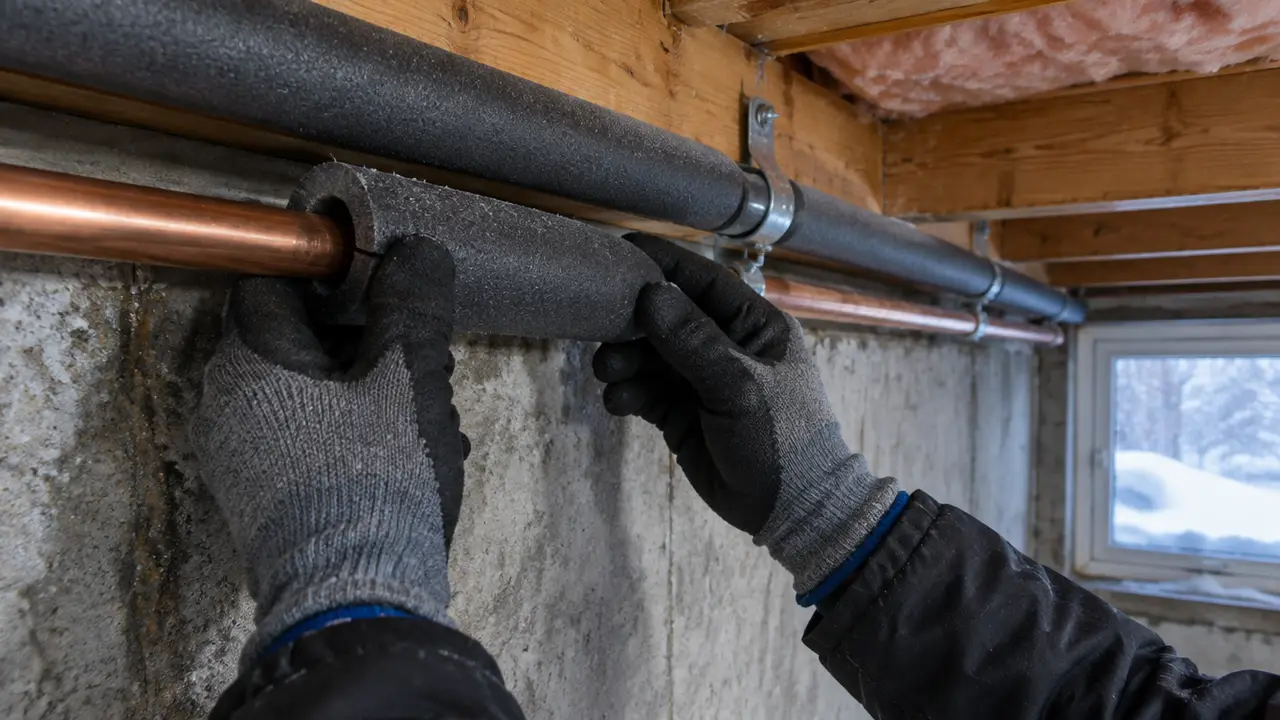
- Fit the right size. Sleeves are sized to the pipe's outside diameter; a loose sleeve leaves an air gap along the pipe.
- Close every seam. Tape or seal the slit and the butt joints. Gaps at elbows, tees and valves are where freezing starts.
- Cover the fittings. Cut mitred pieces for elbows and wrap valves, leaving handles usable.
- Pick the thickness for the space. 13 mm suits heated but cool areas; 19 to 25 mm helps in colder spaces, paired with heat where the space stays below zero.
- Protect foam outdoors and in garages. Sunlight and knocks break down some foams; cover or choose a product rated for the location.
03 /Can insulation make a pipe more likely to freeze?
Yes, when it is put on the wrong side. A pipe in an exterior wall stays thawed mostly because heat leaks to it from the room. If someone wraps that pipe in foam, or packs batt insulation tightly between the pipe and the drywall, the pipe loses its heat supply and sits on the cold side of the insulation with the sheathing. The same thing happens when a renovation adds insulation around a pipe in a floor over a garage.
The rule is simple: in an exterior assembly, the insulation belongs between the pipe and the outside, and the pipe belongs on the warm side, as close to the room as possible. When a pipe in a wall freezes every year after a renovation, this is one of the first things to check. The where pipes freeze guide lists the other usual causes.
04 /How does heat cable work?
Heat cable, often called heat tape or heat trace, is an electric heating element run along or spiralled around a pipe to replace the heat the pipe loses. With insulation over it, a modest cable output can keep a pipe above freezing through a long cold snap, as long as the power stays on. Calgary's frozen-pipe advice lists insulating pipes with sleeves or listed heat tape, and EPCOR suggests heat tape on exterior lines.
| Feature | Self-regulating cable | Constant-wattage cable |
|---|---|---|
| How output changes | Rises as the pipe gets colder, falls as it warms | Same output whenever powered |
| Control | Often plugged in all winter; may include a thermostat | Relies on a built-in or separate thermostat |
| Overlap and crossing | Many products permit it; check instructions | Usually not allowed; overlaps can overheat |
| Cutting to length | Some can be cut and terminated with kits | Usually fixed length |
| Plastic pipe | Check the product is approved for plastic pipe | Check approval; may need foil tape under it |
| Typical use | Crawlspaces, garages, mobile home lines | Short runs, simple kits |
05 /When does a pipe need heat cable instead of foam?
A pipe needs heat when it runs through a space that stays below zero for days: a vented crawlspace, an unheated garage, a cottage under-floor space, a mobile home skirt or an exposed supply to a barn or shop. In those places, the calculator shows that even 25 mm of foam gives only hours. Heat cable under insulation turns a delay into protection, as long as the power stays on.
Heat cable is also the usual retrofit when a pipe has frozen before and cannot easily be moved. The Pipe Freeze Risk Checker reflects this: working heat cable with insulation subtracts 2 points, foam alone adds nothing, and no protection adds 2. Its action list for a pipe that has frozen before names rerouting, heat cable, or sealing and insulating the cavity.
Heat cable is not a substitute for fixing a draft. A cable fighting a gale through an unsealed rim joist has to work much harder, and when the power fails, the draft freezes the pipe faster than foam alone would. Seal first, insulate second, and add heat where the space still stays below zero.
06 /What does heat cable cost to run?
Running cost depends on the cable's output, its length and how much of the winter it actually draws power. A thermostat or self-regulating cable draws much less than its rating in mild weather. As a rough illustration only, a cable drawing an average of 50 watts for 90 days uses about 108 kWh, which at an assumed $0.12 to $0.20 per kWh is roughly $13 to $22 for the season. Check the rating on your cable and your own electricity rate.
Installed costs for foam, cable, a new outlet and rerouting are on the frozen pipe prevention cost page. For a pipe that freezes every year, compare those with the cost of rerouting it through heated space, which removes the need for power at all.
07 /What should I check every fall?
- Walk every exposed run of foam and re-tape any split seams or gaps at fittings.
- Plug in each heat cable before the first cold night and confirm its indicator light, or feel for warmth at the pipe once the thermostat calls for heat.
- Inspect cables for cracks, scorching, crushed sections or brittle jackets, and replace damaged ones.
- Test the ground-fault outlet the cable is plugged into.
- Look for new drafts at the rim joist and pipe penetrations; Natural Resources Canada's air leakage guide covers sealing them.
- Note which pipes depend on power, and plan what you will do in an outage: see keeping pipes from freezing when away.
FAQQuestions people ask
Is foam pipe insulation enough to prevent freezing?
Only where the pipe gets some heat, such as a cool basement or a sink cabinet with the doors open. In a space that stays below zero for days, foam only delays freezing; the pipe also needs heat cable, flowing water or rerouting.
How thick should pipe insulation be?
13 mm is common for heated but cool spaces. 19 to 25 mm helps in colder spots. In this site's model, going from 13 to 25 mm on a ½-inch pipe at −10 °C adds only about two and a half hours.
Can heat cable be used on PEX pipe?
Many products are approved for plastic pipe, but not all, and some require foil tape under the cable. Check the product's markings and instructions before installing it on PEX or other plastic.
Should heat cable be covered with insulation?
Usually yes, because insulation keeps the heat on the pipe, but only if the cable's instructions allow it and with the type of insulation they specify.
Can I leave heat cable plugged in all winter?
Many self-regulating and thermostat-controlled cables are designed for that. Check the instructions, test it each fall and replace it if it shows damage or has reached its stated service life.
Why did my pipes freeze even with heat tape?
Common reasons are a failed or unplugged cable, a tripped ground-fault outlet, a power outage, a gap in the cable run at a valve or fitting, or a draft strong enough to overwhelm it.