No household pipe is freeze-proof. Copper is strong but splits lengthwise once the pressure pocket exceeds its strength. PEX is flexible and often stretches through a freeze without splitting, but its fittings, valves and manifolds can still crack. CPVC and PVC are rigid and crack. Older poly-B and galvanized lines fail at fittings and threads. Material changes how a pipe fails, not whether it freezes.
- Every material freezes at the same temperature; what differs is how each one fails when a pressure pocket forms.
- PEX tolerates freezing better than rigid pipe because it can stretch, but the fittings and valves on a PEX system are rigid and can crack.
- Copper often bulges before it splits, and it can survive one freeze only to fail on a later one.
- CPVC and PVC become more brittle in the cold and tend to crack rather than bulge.
- Switching material is not a substitute for keeping the pipe warm; relocation and sealing matter more.
01 /Does pipe material change whether a pipe freezes?
Barely. Water freezes at 0 °C whatever the pipe is made of, and the time it takes depends mainly on the water's volume, the insulation and the air around the pipe. Plastic pipe conducts heat less than copper, but the thin wall of a household pipe is a tiny part of the total resistance; the still air film around the pipe matters far more. In practice, a PEX line and a copper line in the same drafty wall freeze on the same night.
What the material changes is the outcome. When an ice plug seals a line and the trapped water is squeezed, as described in why frozen pipes burst, a flexible pipe can stretch and relieve some pressure, a ductile metal pipe bulges and then tears, and a rigid plastic pipe or fitting cracks.
02 /How does each material behave in a freeze?
| Material | Where you find it | Typical freeze behaviour | Weak points |
|---|---|---|---|
| Copper (types K, L, M) | Most homes from the mid-20th century on; service lines | Bulges, then splits lengthwise | Thin-wall runs, soldered joints, valves |
| PEX (cross-linked polyethylene) | Many newer homes and renovations | Often stretches without splitting | Brass or plastic fittings, crimp or clamp rings, manifolds, fixture valves |
| CPVC | Some homes built or renovated from the 1980s onward | Cracks; brittle in cold | Solvent-welded joints, transitions, stubs at walls |
| PVC (cold water only) | Some service lines and cold-water runs | Cracks | Joints and fittings |
| Polybutylene (poly-B) | Homes from roughly the late 1970s to the 1990s | Tube is flexible; fittings are the known weakness | Fittings and crimp rings; ask your insurer |
| Galvanized steel | Older homes, often mid-20th century | Splits at threads or corroded spots | Threaded joints, internal corrosion |
| Polyethylene tubing | Buried water services, well and cottage lines | Flexible; fittings and valves can fail | Insert fittings and clamps |
Treat the table as general patterns. How any given line fails also depends on its age, the fittings chosen, how it was supported and how many times it has frozen before. Repairs by material, and whether a cracked fitting can be replaced on its own, are covered by BurstPipe.ca.
03 /Is PEX freeze-proof?
No. PEX is more forgiving than rigid pipe because the tube can expand under the pressure of freezing water and often returns close to its original size after thawing. That makes a split in the tube itself less likely than in copper or CPVC. It does not make a PEX system freeze-proof, and the parts most likely to fail are the ones that cannot stretch.
- Fittings: brass and plastic elbows, tees and couplings are rigid. A pressure pocket can crack a plastic fitting or push a connection apart.
- Manifolds and valves: a manifold in a cold space or a stop valve at the end of a frozen run can crack when water behind it is squeezed.
- Fixture connections: faucet cartridges, toilet fill valves and appliance valves at the far end of a frozen line take the pressure first.
- Repeated freezing: a tube that has frozen more than once may be stretched or stressed; treat it as damaged if it looks swollen.
- Ice still blocks the flow: even if nothing breaks, a frozen PEX line leaves you without water, and it must be thawed gently. Never use a flame or a heat gun on it.
04 /How do copper pipes fail when they freeze?
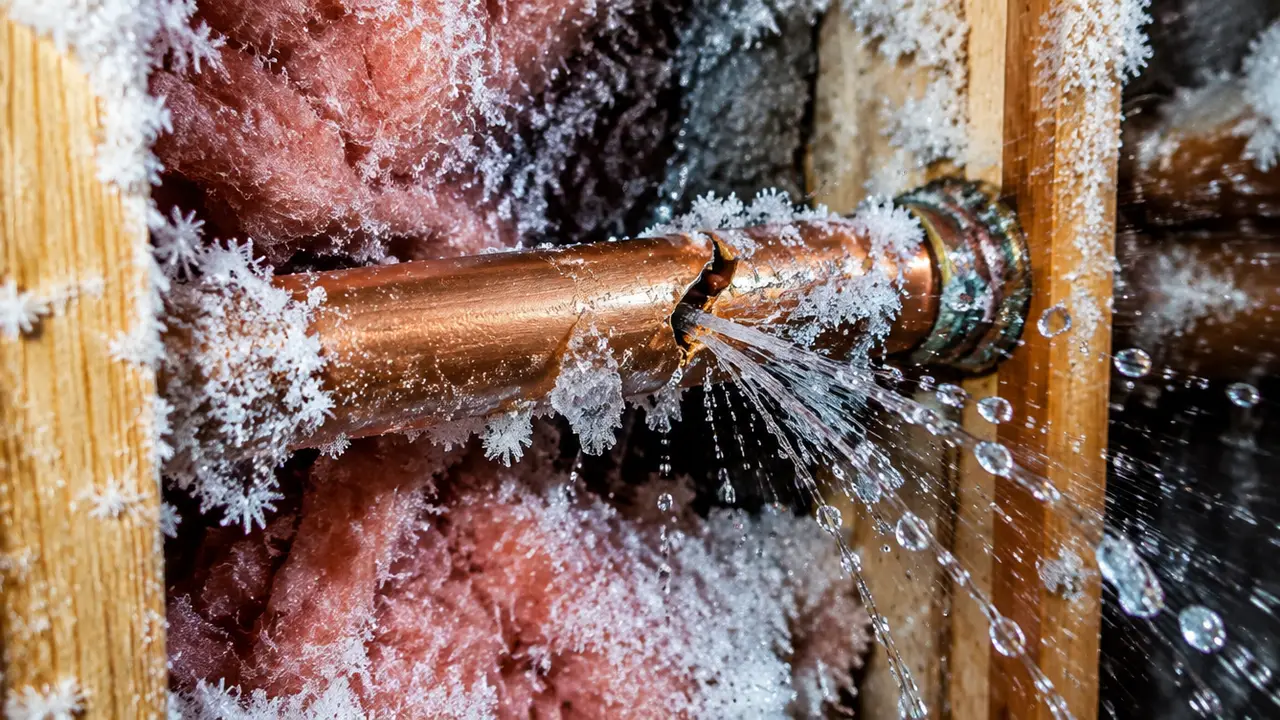
Copper is ductile, so under a rising pressure pocket it first swells and then tears, usually as a lengthwise slit a few centimetres long in the water-filled section beyond the ice. Thin-wall copper, the most common type for interior branches, needs less pressure to split than heavier grades. Soldered joints and valve bodies can also let go.
Copper's ductility has a hidden cost. A line can bulge slightly on one freeze without leaking, which makes it look fine, and then split on the next. If you find a slightly swollen section on a line you know has frozen, treat it as weakened. The durable answer is almost always to fix the cause: move the line to the warm side of the wall, seal the draft, or add heat cable under insulation, as covered in pipe insulation and heat cable.
05 /What about CPVC, PVC, poly-B and galvanized?
CPVC is rigid and becomes more brittle as it gets colder. It tends to crack rather than bulge, and cracks often start at solvent-welded joints or at stub-outs where the pipe comes through a wall. It also needs care when thawing, because too much heat can soften it; use only gentle warmth.
PVC is used for cold water in some service lines and runs. Like CPVC it cracks when frozen, and it should not be heated with anything hotter than warm air or warm towels.
Polybutylene, the grey flexible pipe often called poly-B, was installed in many Canadian homes from roughly the late 1970s through the 1990s. Its best-known weakness is the fittings rather than freezing, and many insurers ask about it or treat it differently. If you have poly-B in a cold spot, the freezing and fitting risks add up; ask your insurer how it affects your coverage.
Galvanized steel in older houses is strong but rusts from the inside and is joined with threads, which are thinner than the pipe wall. A freeze tends to split it at a threaded joint or a corroded spot. Because galvanized lines also narrow over time, they sit still with less flow, which does not help.
06 /Should I replace my pipes with PEX to stop freezing?
Only if you are replacing them anyway, and never as the only fix. Changing a copper branch in an exterior wall to PEX may reduce the chance of a split on the next freeze, but the new line will still freeze, still leave you without water and still stress its fittings. The same dollars spent moving the line to the warm side of the insulation, sealing the draft or adding heat cable remove the freeze altogether.
Where a line must be replaced after a freeze, it is a good moment to reroute it. Ask the installer to keep supply lines out of exterior walls, garage ceilings and cantilevers where possible, and to keep any line that must pass through cold space on the warm side of the insulation. Planning ranges for rerouting are on the prevention cost page.
The plumbing code sets which materials may be used for water supply in your province; the National Plumbing Code of Canada is the model most provinces adopt, sometimes with changes. A plumber or your municipality can confirm what applies to your house.
07 /Can I tell what pipe I have?
- Copper: reddish-brown or dull brown metal, soldered joints, often with coloured printed markings along the pipe.
- PEX: flexible plastic tubing, usually white, red or blue, with printed markings and crimped, clamped or expansion fittings.
- CPVC: rigid cream or light-yellow plastic with glued joints.
- Poly-B: flexible grey plastic, often with metal or plastic crimp-ring fittings.
- Galvanized steel: grey metal with threaded joints; a magnet sticks to it.
- Polyethylene service tubing: black flexible tubing where the service enters the house, often with clamped insert fittings.
Look where the water service comes into the basement and at exposed lines near the water heater. Many homes have more than one material after renovations. Knowing yours helps you decide how to thaw safely, as the thawing guide explains, and what to tell a plumber or insurer.
FAQQuestions people ask
Do PEX pipes burst when they freeze?
The tube itself often stretches instead of splitting, but PEX systems still fail at rigid fittings, manifolds and valves, and a frozen PEX line still leaves you without water. Treat it as freeze-resistant, not freeze-proof.
Will copper pipes always burst if frozen?
No. Whether copper splits depends on whether a sealed pressure pocket forms. Copper may bulge and survive one freeze, then split on a later one, so a line that has frozen before deserves attention.
Can frozen CPVC pipes be thawed safely?
Yes, with gentle heat only: warm the room, use warm towels or a hair dryer on low. Never use a heat gun or flame, which can soften or crack the pipe.
Are plastic pipes better in cold climates?
Flexible plastics such as PEX tolerate a freeze better than rigid pipe, but the fittings remain a weak point, and rigid plastics such as CPVC and PVC crack. Keeping the pipe warm matters more than the material.
Is poly-B more likely to burst from freezing?
The tube is flexible, but poly-B systems are known for fitting failures, and freezing adds stress at those fittings. If you have poly-B in a cold spot, protect it and ask your insurer how it affects coverage.